The construction safety hierarchy is a ranked framework that orders hazard control measures from most to least effective, guiding construction professionals to protect workers through systematic risk reduction. Formally known as the hierarchy of controls, this system is mandated by regulatory bodies including OSHA and HSE, and forms the backbone of standards like ISO 45001 and OSHA 29 CFR 1926. With 2026 compliance expectations raising the bar on documentation and evidence, every safety officer needs a clear understanding of the construction safety hierarchy explained in full, from elimination down to personal protective equipment (PPE).
What are the five levels of the construction safety hierarchy?
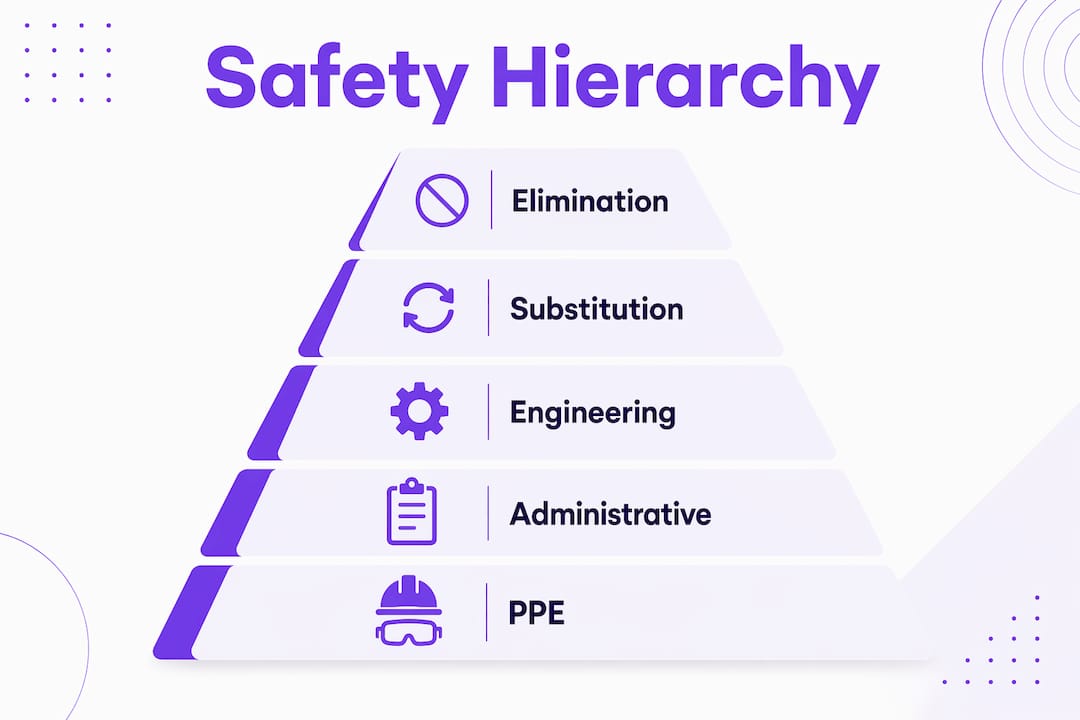
The hierarchy of controls ranks five intervention levels from most to least effective: Elimination, Substitution, Engineering Controls, Administrative Controls, and PPE. Regulatory bodies like HSE and OSHA require documented proof that higher-level controls were considered before defaulting to lower ones. A useful memory aid is the ERIC-PD mnemonic, which maps directly to these five levels in order.
Each level carries a different degree of reliability, and that difference is significant in practice.
- Elimination removes the hazard entirely. On a construction site, this means redesigning a task so the danger no longer exists. Removing a chemical from the process or eliminating the need to work at height through prefabrication are clear examples.
- Substitution replaces a hazardous material or method with a safer one. Swapping solvent-based adhesives for water-based alternatives reduces chemical exposure without eliminating the task.
- Engineering Controls physically separate workers from the hazard. Guardrails, machine guards, and local exhaust ventilation all fall here. These controls work independently of worker behavior, which makes them far more reliable than training alone.
- Administrative Controls change how work is done. Job rotation schedules, permit-to-work systems, and toolbox talks are common examples. These depend entirely on worker compliance, which is their core weakness.
- PPE is the last line of defense. Hard hats, harnesses, and respirators protect the individual but do nothing to reduce the hazard itself.
The hierarchy prioritizes physical controls that remove human error risk, because these work regardless of worker behavior. Administrative controls and PPE, by contrast, fail the moment a worker forgets or skips a step.
Pro Tip: Use the ERIC-PD mnemonic during every job safety analysis (JSA) to check that your team has genuinely considered higher-level controls before reaching for PPE.

How does the hierarchy apply to fall protection in 2026?
Falls remain the leading cause of construction fatalities, and the safety hierarchy in construction applies directly to fall hazard control. The principle is straightforward: passive fall prevention always takes priority over active fall protection.
2026 regulatory standards prioritize passive fall-prevention devices such as scaffolding and guardrails over active PPE fall protection like harnesses. OSHA 1926.502 mandates guardrail systems that sit 42 inches above the working surface and withstand 200 pounds of force. That specification exists because collective protection removes the risk for every worker on the platform, not just the one wearing a harness.
| Control level | Fall protection example | Reliability |
|---|---|---|
| Elimination | Off-site prefabrication of roof panels | Highest |
| Engineering control | Guardrails, scaffolding, safety nets | High |
| Administrative control | Exclusion zones, height work permits | Moderate |
| PPE | Safety harness, lanyard, anchor point | Lowest |
Harnesses are not a primary control. They are a backup for situations where engineering controls are not feasible. A harness only works if it is correctly fitted, properly anchored, and worn at all times. That is three separate points of human error.
Safety culture compliance adds another layer of urgency. As of July 2026, the Safety Culture Ladder requires companies to meet Level 3 for government tenders, but over 25% of construction companies fall below that threshold. Companies below Level 3 risk contract exclusion, not just safety incidents.
Pro Tip: When fall hazards cannot be eliminated, install guardrails before scheduling the task. Only issue harness requirements as a supplementary control, never as the primary one.
What are the key challenges in implementing the hierarchy on site?
The most common implementation failure is treating the hierarchy as a pick-one menu. Practitioners should apply layered defenses combining engineering, administrative, and PPE controls, each justified by evidence. Relying solely on PPE for major hazards is a red flag in any safety audit.
Documentation is the second major failure point. Moving down the hierarchy to a lower-level control requires written justification. Safety officers must record why elimination or substitution was not feasible, not simply state that PPE was issued. ALARP demonstrations in 2026 increasingly demand evidence-based numerical cost-benefit analysis explaining why higher-level controls were rejected. Narrative justifications no longer satisfy auditors or regulators.
Three implementation principles separate high-performing sites from the rest:
- Integrate JSA with permits and toolbox talks. A JSA document that sits in a folder is not a control. Job Safety Analysis documents must link directly to permits and be actively reviewed during daily toolbox talks. The common failure is creating the document but never enforcing it on site.
- Apply Prevention through Design early. Prevention through Design emphasizes eliminating hazards during the design or prefabrication stage, before construction begins. Modular off-site fabrication can eliminate the need for high-risk work like working at height entirely.
- Document every control decision. Record the specific reason a higher-level control was rejected. Quantified risk assessments carry more weight than general statements about cost or practicality.
"The hierarchy of controls is not a checklist to complete. It is a discipline that demands you prove, in writing, that you chose the safest feasible option at every step. Anything less is not compliance. It is documentation theater."
Construction risk management at a mature level means designing hazards out of the project before the first worker sets foot on site. That mindset shift is what separates Level 3 safety culture from the rest.
How can safety officers improve compliance using the hierarchy?
Safety officers who embed the hierarchy into daily operations see measurable improvements in both compliance and incident rates. The key is moving the hierarchy from a planning document into a live site practice.
- Conduct task-specific JSAs for every high-risk activity. Generic risk assessments do not satisfy OSHA 29 CFR 1926 or ISO 45001 requirements. Each task needs its own analysis tied to the specific hazards present that day.
- Integrate hierarchy review into permit-to-work systems. Every permit should require the issuing officer to confirm which control level is in place and why lower-level controls were not sufficient on their own.
- Use off-site prefabrication where feasible. Prefabrication and modular construction reduce on-site hazards by moving hazardous tasks off site, improving safety outcomes in residential projects. This is the most direct application of elimination and substitution at scale.
- Run toolbox talks that reference the hierarchy by name. Workers who understand why guardrails come before harnesses are more likely to report when guardrails are missing. Safety culture grows when the reasoning is shared, not just the rule.
- Audit controls against the hierarchy quarterly. Controls that were appropriate at project start may become inadequate as site conditions change. Regular audits tied to Safety Culture Ladder criteria keep compliance current.
Residential construction sites often exhibit PPE-only cultures. Advancing beyond that requires deliberate effort from safety officers who push for engineering controls and design changes, not just better PPE compliance.
Key Takeaways
The hierarchy of controls is the most reliable framework for construction risk management because it prioritizes measures that work independently of human behavior, from elimination down to PPE.
| Point | Details |
|---|---|
| Elimination is the gold standard | Design out hazards before construction begins using prefabrication or task redesign. |
| PPE is a last resort, not a primary control | Harnesses and hard hats protect individuals but do not reduce the hazard for the site. |
| Layered controls outperform single measures | Combine engineering, administrative, and PPE controls with documented justification for each. |
| Documentation drives 2026 compliance | ALARP justifications now require quantified cost-benefit analysis, not narrative statements. |
| Safety culture determines contract eligibility | Over 25% of construction companies fall below Safety Culture Ladder Level 3, risking tender exclusion. |
Why the hierarchy still gets ignored on too many sites
The hierarchy of controls has been standard practice for decades. Yet site audits consistently reveal the same pattern: PPE issued, guardrails missing, JSA filed but never reviewed. After years of reviewing safety programs across construction projects, the pattern is clear. The hierarchy fails not because safety officers do not know it, but because site culture treats it as a compliance exercise rather than a decision-making tool.
The 2026 shift toward evidence-based ALARP documentation is the most meaningful regulatory change in years. It forces safety officers to justify every control decision in writing, with numbers. That accountability is long overdue. Sites that have adopted this approach report fewer last-minute PPE-only workarounds because the documentation burden makes the shortcut visible.
Prevention through Design is where the real gains are. When structural steel is prefabricated off site, the fall hazard does not exist on site. No harness program, no exclusion zone, no toolbox talk about working at height. The hazard is gone. That is the hierarchy working as intended, and it requires safety input at the design stage, not after the scaffold is up.
The moral case is straightforward. Workers should not rely on remembering to clip in. They should work in environments where the hazard has been removed or contained by design. Every time a safety officer accepts a PPE-only solution for a hazard that engineering could have controlled, that is a decision with consequences.
— FAIR A. R.
Fairsafe supports your hierarchy of controls compliance
Construction safety compliance requires more than a policy document. It requires certified personnel on site, ready to respond and trained to WorkSafe BC standards.
Fairsafe provides certified first aid and safety services for construction sites across Metro Vancouver, with rapid deployment and transparent pricing that fits real project budgets. Our certified first aid attendants support risk assessment documentation, control verification, and on-site compliance with OSHA, ISO 45001, and Safety Culture Ladder requirements. Whether your project needs a single attendant or a full safety coverage plan, Fairsafe delivers dependable service without hidden costs. Contact Fairsafe to discuss your site's safety requirements and get a clear quote today.
FAQ
What is the hierarchy of controls in construction?
The hierarchy of controls is a ranked framework ordering hazard control measures from Elimination to PPE. Regulatory bodies including OSHA and HSE require documented proof that higher-level controls were considered before lower ones are applied.
Why is PPE considered the least effective control?
PPE depends entirely on correct and consistent use by each worker, making it vulnerable to human error. Engineering controls and elimination work regardless of worker behavior, which makes them far more reliable.
What does OSHA 1926.502 require for fall protection?
OSHA 1926.502 mandates guardrail systems positioned 42 inches above the working surface, capable of withstanding 200 pounds of force. These passive systems take priority over active PPE like harnesses under the safety hierarchy in construction.
What is the Safety Culture Ladder Level 3 requirement in 2026?
As of July 2026, companies must meet Safety Culture Ladder Level 3 to qualify for government construction tenders. Over 25% of construction companies currently fall below this threshold, putting them at risk of contract exclusion.
How does Prevention through Design apply to construction safety?
Prevention through Design eliminates hazards during the planning or prefabrication stage before workers arrive on site. Off-site modular fabrication, for example, removes the need for high-risk work at height entirely, applying elimination at the highest level of the hierarchy.