
A construction site safety inspection checklist is a systematic tool that identifies hazards, confirms regulatory compliance, and protects workers before a single shift begins. Under 2026 OSHA standards, willful violations carry penalties up to $170,181 per citation. That number alone makes a structured inspection program one of the most cost-effective decisions a site manager can make. Documented self-inspections can reduce those penalties by up to 25% through good faith credit, which means your paperwork is not just a formality. It is a financial and legal shield.
What should a construction site safety inspection checklist include?
A complete daily checklist covers 7–8 core hazard categories and spans 50–54 items, requiring roughly 10–15 minutes per inspection. That time investment is small compared to the cost of a recordable incident or a failed OSHA audit. Each category targets a specific failure point that construction sites face every day.
The table below maps each core category to its most critical checklist items.
| Category | Example checklist items |
|---|---|
| Personal Protective Equipment (PPE) | Hard hats, high-visibility vests, safety glasses, gloves, steel-toed boots |
| Fall protection | Guardrails, safety nets, personal fall arrest systems, ladder inspections |
| Scaffolding | Platform integrity, load capacity tags, access points, bracing |
| Electrical safety | Lockout/tagout compliance, GFCI protection, cord condition, panel access |
| Heavy equipment | Pre-operation checks, operator certification, swing radius barriers |
| Hazard communication | SDS availability, chemical labeling, spill containment |
| Housekeeping | Clear walkways, debris removal, material storage |
| Emergency preparedness | First aid kit location, AED access, evacuation routes, muster points |
PPE and fall protection
PPE checks confirm that every worker on site has the correct gear for their specific task. A roofer needs a full fall arrest harness. A welder needs a face shield rated for their arc voltage. Generic checks miss these distinctions. Fall protection is the single largest category of OSHA citations in construction, so each guardrail, anchor point, and ladder must be physically verified, not assumed.

Electrical safety and lockout/tagout
Lockout/tagout (LOTO) procedures prevent accidental energization of equipment during maintenance. Your checklist should confirm that LOTO devices are applied, tagged with the responsible worker's name, and logged. GFCI protection must be verified at every temporary power outlet on site. A missing GFCI is a citation waiting to happen and a serious electrocution risk.
Emergency preparedness and first aid
Every site checklist must confirm that first aid supplies are stocked, accessible, and not expired. An automated external defibrillator (AED) must be present and functional on sites that meet WorkSafe BC thresholds. Evacuation routes should be posted and unobstructed. These items are not optional additions to a checklist. They are baseline requirements under both OSHA and WorkSafe BC regulations.
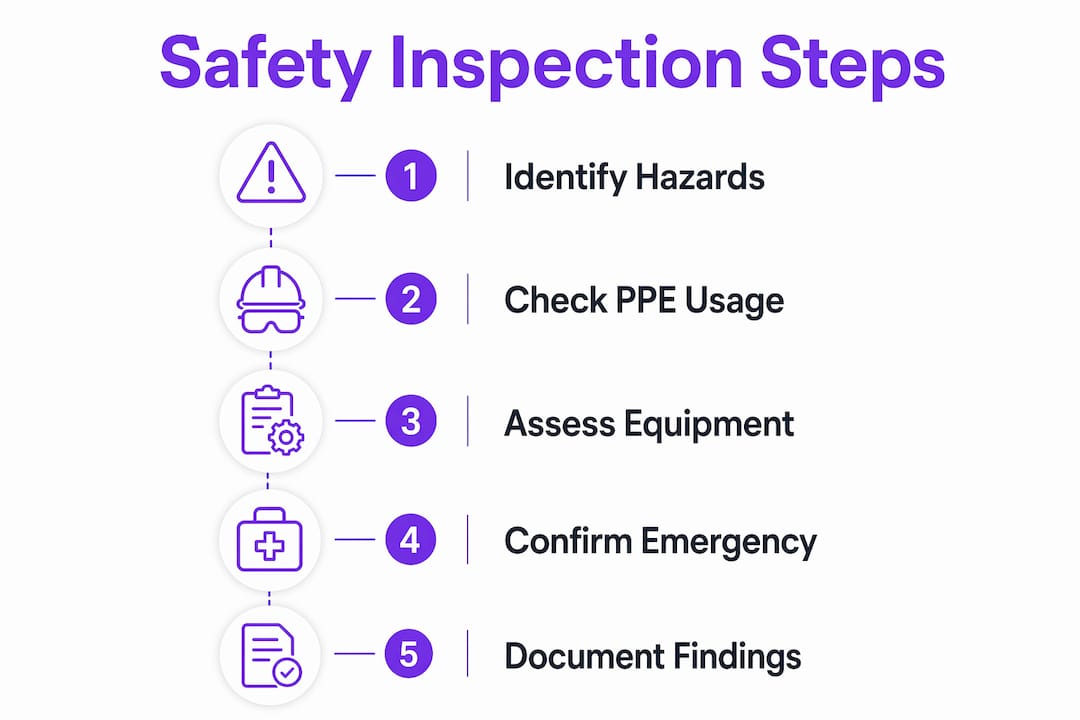
Pro Tip: Customize your checklist to reflect the top three hazards specific to your current phase of construction. A foundation pour has different risks than steel erection, and your checklist should reflect that difference.
How often should safety inspections happen on a construction site?
Inspection frequency should follow a tiered structure: daily for immediate hazards, weekly for equipment and systems audits, and monthly for training records and emergency drills. Each tier serves a different purpose and catches different types of failures.
- Daily pre-shift walkthrough: A rapid 10–15 minute inspection identifies new hazards introduced overnight, by weather changes, or by subcontractor activity. This is your first line of defense.
- Weekly audit: A deeper review covering fire extinguisher tags, electrical connection integrity, scaffold load ratings, and equipment maintenance logs. Weekly audits catch slow-developing issues that daily walkthroughs miss.
- Monthly review: Covers training record currency, emergency drill completion, incident trend analysis, and a full review of corrective actions from prior months. Monthly reviews are where you assess whether your safety program is actually working.
The tiered structure matters because different hazards operate on different timelines. A missing guardrail is a daily risk. An expired fire extinguisher is a monthly risk. Treating every inspection as the same level of detail wastes time and misses the point of each tier.
Pro Tip: Align your monthly review date with your training schedule. If your first aid certifications expire in march, your february monthly review should flag every worker who needs recertification before the deadline.
What are best practices for documentation and corrective actions?
Documented inspections and corrective actions demonstrate active safety management and directly improve outcomes during OSHA inspections. A written record proves you identified a hazard and addressed it. Without that record, you have no defense.
Follow this workflow for every inspection:
- Complete the checklist in writing. Digital or paper formats both work, but the record must be dated, signed by the inspector, and retained for at least three years.
- Log every deficiency with a severity rating. Capture hazard severity, likelihood, and impact for each finding. A wet floor near electrical panels is high severity. A missing sign on a storage shed is low severity. Treat them differently.
- Assign a corrective action owner and deadline. Every deficiency needs a named person responsible for fixing it and a specific date for completion. Unassigned items never get resolved.
- Track near-misses separately. Near-miss events predict serious injuries. A worker who almost falls from a scaffold is a warning that the fall protection system has a gap. Log it, investigate it, and fix the root cause.
- Verify corrective action completion. Close out each item only after a follow-up inspection confirms the fix. An open corrective action that never closes is evidence of negligence, not diligence.
- Integrate records into your written safety program. Written safety programs should include pre-project hazard analysis, daily assessments, job hazard analysis, and change management documentation. Your inspection logs feed directly into that program.
Pro Tip: Use a simple numbering system for corrective actions so you can reference them across multiple inspection cycles. "CA-2026-047" is easier to track than "the scaffold issue from last month."
What mistakes do construction managers make during safety inspections?
The most common inspection failures are not technical. They are behavioral and organizational. Recognizing them is the first step to fixing them.
- Using a generic checklist. A template downloaded from the internet covers general hazards but misses site-specific risks. A demolition site has asbestos exposure risks that a new residential build does not. Your checklist must reflect your actual site.
- Rushing the inspection. A 10-minute walkthrough done in 3 minutes is not an inspection. It is a liability. Inspectors who rush miss critical items and create false documentation records.
- Failing to train the competent person. OSHA requires that inspections be conducted by a "competent person," defined as someone capable of identifying existing and predictable hazards. That person needs formal training, not just job experience.
- Ignoring follow-up on corrective actions. Identifying a hazard and not fixing it is worse than not identifying it at all. It proves you knew about the risk and did nothing.
- Not updating the checklist for 2026 OSHA changes. OSHA updates penalty structures and standards regularly. A checklist built in 2022 may miss current requirements for silica exposure, heat illness prevention, or fall protection in residential construction.
"The most dangerous checklist is one that gives you confidence without giving you accuracy. A box checked without a physical verification is just paperwork."
Pro Tip: Hold a brief weekly team meeting where workers can flag hazards they noticed but did not see on the checklist. Workers on the ground often spot risks before supervisors do.
Key takeaways
A complete, site-specific construction safety inspection checklist, conducted daily and documented thoroughly, is the most direct path to OSHA compliance and worker protection in 2026.
| Point | Details |
|---|---|
| Cover all 8 core categories | Daily checklists must address PPE, fall protection, electrical, equipment, hazard communication, housekeeping, scaffolding, and emergency preparedness. |
| Use a tiered inspection schedule | Daily walkthroughs take 10–15 minutes; weekly and monthly audits go deeper into systems, training, and trends. |
| Document every finding | Written records with severity ratings and corrective action owners reduce OSHA penalties and prove active safety management. |
| Track near-misses | Near-miss logging predicts serious injuries and identifies gaps in your safety program before an incident occurs. |
| Customize for your site | Generic templates miss site-specific hazards; tailor your checklist to the current phase and conditions of your project. |
Why I stopped trusting generic checklists on complex sites
After working across multiple construction environments, the pattern is clear: the sites with the most thorough paperwork are not always the safest. The sites with the most accurate paperwork are. There is a real difference.
Generic checklists create a false sense of coverage. A 54-item template feels thorough until you realize it does not mention the specific crane swing radius on your current project or the confined space entry point behind the mechanical room. Concise, site-specific safety plans of around 12 pages consistently outperform lengthy generic templates because they reflect actual conditions. Inspectors notice the difference immediately.
The other mistake I see repeatedly is treating the checklist as a solo activity. The site superintendent walks the site alone, checks boxes, and files the form. That approach misses the knowledge that workers carry. The electrician who noticed a frayed cord two days ago. The scaffold crew who knows one brace is slightly off. Involving your team in the inspection process does not slow you down. It makes your checklist more accurate than any template ever could.
Early hazard identification before finalizing your safety plan is where the real value lies. When you inspect first and plan second, your safety program reflects reality. When you plan first and inspect later, you are managing a document instead of a worksite.
— Nassif
Fairsafe supports your construction site safety compliance
Construction site safety compliance requires more than a checklist. It requires certified personnel, proper first aid coverage, and documentation that holds up under WorkSafe BC scrutiny.

Fairsafe provides certified first aid attendants, AED deployment, and safety services in Metro Vancouver built specifically for construction sites and industrial worksites. Our staff meet WorkSafe BC requirements, deploy rapidly, and operate at transparent, fair pricing. Whether you manage a single site or multiple active projects, Fairsafe gives you the coverage and documentation support to stay compliant without overpaying for it. Contact Fairsafe to discuss your site's specific requirements and get a clear quote with no surprises.
FAQ
What is a construction site safety inspection checklist?
A construction site safety inspection checklist is a structured document used to identify hazards, verify compliance with OSHA and WorkSafe BC standards, and confirm that protective measures are in place before and during active work. It typically covers 7–8 hazard categories across 50–54 items.
How long does a daily safety inspection take?
A daily pre-shift inspection takes 10–15 minutes when the checklist is well-organized and site-specific. Longer inspections are not always better. A focused, accurate 12-minute walkthrough outperforms a rushed 30-minute one.
What happens if OSHA finds violations during a site inspection?
OSHA willful violations carry penalties up to $170,181 per citation in 2026. Documented self-inspections and written safety programs with corrective action records can reduce those penalties by up to 25% through good faith credit.
Who is qualified to conduct a construction site safety inspection?
OSHA requires inspections to be conducted by a "competent person," defined as someone trained to identify existing and predictable hazards. That person must have both formal safety training and the authority to take corrective action on site.
How do I make my safety checklist site-specific?
Start with a pre-project hazard analysis that identifies the top risks for your current construction phase. Update the checklist whenever site conditions change, new subcontractors arrive, or weather introduces new hazards. A checklist that never changes is a checklist that stops working.