
Construction safety violations are defined as specific breaches of WorkSafeBC regulations and OSHA-aligned standards that directly endanger workers and expose employers to fines, project shutdowns, and criminal liability. The most common types of construction safety violations in British Columbia involve fall protection failures, ladder misuse, hazard communication gaps, scaffolding errors, and equipment-related breaches. The "Fatal Four" hazards, which include falls, struck-by incidents, electrocutions, and caught-in/between accidents, cause nearly 60% of construction deaths across North America. Understanding each category gives B.C. construction professionals a direct path to closing compliance gaps before an inspector or an incident forces the issue.
1. What are fall protection violations and why do they lead all construction citations?
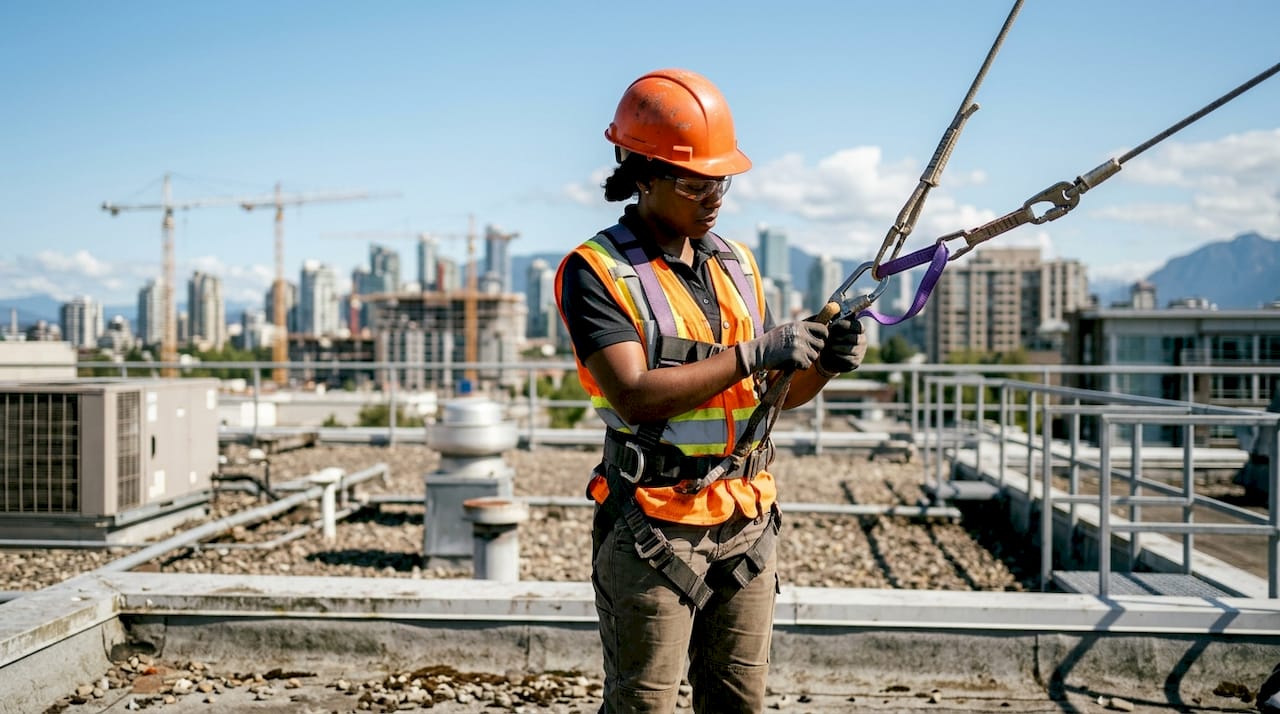
Fall protection violations are the single most cited construction safety breach in North America, and B.C. sites are no exception. Fall protection generated 5,914 citations in FY2025 alone and accounts for 33.5% of all construction fatalities. That number means roughly one in three construction deaths traces back to a missing guardrail, an inadequate harness, or a failed anchor point.
The most common fall protection failures on B.C. sites include:
- Missing or damaged guardrails on open-sided floors and rooftops
- Harnesses worn incorrectly or attached to non-rated anchor points
- No fall arrest system in place for workers above 10 feet on scaffolding or 6 feet in general construction
- Unprotected floor openings and roof hatches
The height threshold creates a compliance trap that catches many crews off guard. Fall protection requirements differ by context: scaffolding triggers requirements at 10 feet, while general construction work triggers them at 6 feet. A single site can carry both thresholds simultaneously, which means a crew moving between scaffold and roof work must shift their compliance posture mid-task.
Pro Tip: Before each shift, assign one competent person to physically inspect every anchor point, harness connection, and guardrail section. Document the check in writing. WorkSafeBC inspectors treat documented inspections as evidence of due diligence.
2. How do ladder safety violations occur on B.C. construction sites?
Ladder violations are the second most common construction safety breach, and they are almost always preventable. Ladder safety generated 2,681 citations in FY2024 with an average fine of $3,500 per citation. That financial exposure adds up fast on a multi-trade project.
The most frequent ladder violations follow a predictable pattern:
- Failure to extend the ladder 3 feet above the landing. Workers step off at the top rung with nothing to grip, losing balance on dismount.
- Improper angle setup. The correct ratio is 1 foot out for every 4 feet of height. Steeper angles cause tip-overs; shallower angles cause the base to slide.
- Using a damaged ladder. Cracked rails, bent rungs, and missing feet are common on busy sites where equipment gets moved daily.
- Unsecured ladders. A ladder leaning against a wall without ties or a spotter is a citation waiting to happen.
- Wrong ladder for the task. Using a stepladder as a straight ladder, or a ladder rated for light duty on a heavy-use task, violates both manufacturer specs and WorkSafeBC requirements.
The root cause behind most ladder violations is not ignorance of the rules. It is time pressure. Workers skip setup steps when they believe the task will take only a few minutes. Training programs that address this specific behavior, not just the technical rules, produce better results than standard safety orientations.
Pro Tip: Inspect every ladder before use with a formal tag system. A green tag means the ladder passed inspection. A red tag means it is removed from service immediately. This one practice eliminates the "I thought it was fine" defense.
3. What hazards do hazard communication violations introduce on B.C. sites?
Hazard communication violations are defined as failures to properly label chemicals, maintain accessible Safety Data Sheets (SDS), or train workers on the substances they handle. Hazard communication generated 2,546 citations in FY2025, making it a consistent top-three violation category. The health consequences are often delayed, which makes this category easier to overlook than a missing guardrail.
B.C. construction sites regularly expose workers to:
- Crystalline silica from cutting concrete, brick, and stone. Silica dust causes silicosis, an irreversible lung disease.
- Solvents and adhesives used in flooring, roofing, and waterproofing. Many are flammable and acutely toxic in enclosed spaces.
- Epoxy resins and coatings that require specific PPE and ventilation controls not always communicated to workers.
WorkSafeBC requires employers to maintain a current SDS for every hazardous product on site, post chemical inventories in accessible locations, and deliver WHMIS 2015 training before workers handle any controlled product. The most common gap is not the absence of SDS documents. It is that workers cannot locate them when needed, or they have never been shown how to read one.
Practical steps to close this gap include posting SDS binders at the point of use rather than in a trailer office, conducting brief toolbox talks when a new chemical arrives on site, and verifying comprehension with a short verbal check rather than a sign-off sheet.
4. What are common scaffolding violations and their implications for compliance?
Scaffolding violations rank consistently in the top three cited construction standards. Common scaffold citations include missing guardrails, inadequate planking, and missing toeboards. Each of these failures can send a worker or a tool falling onto workers below.
| Violation Type | Specific Failure | Regulatory Consequence |
|---|---|---|
| Missing guardrails | No top rail or mid-rail on scaffold platform | Immediate citation, potential stop-work order |
| Inadequate planking | Gaps between planks or undersized boards | Citation for each affected platform level |
| Missing toeboards | No barrier to prevent tools from rolling off | Citation plus liability for struck-by injuries |
| Improper access | No ladder, stairway, or ramp to platform | Citation for each scaffold without proper access |
| Capacity overload | Workers and materials exceeding rated load | Structural failure risk and serious violation |
Scaffold compliance in B.C. requires a qualified person to inspect the structure before each work shift and after any event that could affect structural integrity, such as high winds or a collision from equipment. The inspection must be documented. Many sites complete the physical setup correctly but fail on the documentation requirement, which is itself a citable offense.
The capacity issue deserves specific attention. Workers routinely stack materials on scaffold platforms to avoid multiple trips. A platform rated for workers and light tools becomes overloaded quickly when it also holds a pallet of tile or a stack of lumber. Post the rated capacity on every scaffold section and enforce it.
5. How do equipment and electrical safety violations manifest on B.C. construction sites?
Equipment and electrical violations represent two distinct but related categories of construction safety breaches, and both carry severe consequences. The equipment side centers on lifting gear, rigging, and powered tools. The electrical side centers on temporary wiring, ground fault protection, and cord management.
On the equipment side, the most common violations include:
- Using non-rated or uninspected lifting slings, shackles, and hooks
- Retaining defective tools in service rather than removing them immediately
- Operating equipment without current inspection documentation
- Failing to conduct pre-use checks on cranes, forklifts, and aerial work platforms
The financial and human cost of non-compliant lifting gear is not theoretical. A record fine of $1.75 million was issued after a death involving a non-compliant rigging device on a construction site. That outcome illustrates what WorkSafeBC enforcement can look like when employers retain equipment they know is unsafe.
"Employers retaining known non-compliant equipment face severe legal consequences, including record fines, highlighting the importance of rigorous equipment audits." — Construction safety enforcement record
On the electrical side, common violations include missing GFCIs, damaged extension cords, and temporary wiring that exceeds permitted durations. Ground fault circuit interrupters are required on all temporary power sources on B.C. construction sites. A single missing GFCI in a wet environment is enough to cause a fatal electrocution.
Pro Tip: Assign a dedicated equipment log to every lifting device and powered tool on site. Log every inspection, every defect found, and every removal from service. This record protects you legally and creates a culture where workers report problems rather than work around them.
Key takeaways
The most effective way to prevent construction safety violations in British Columbia is to treat fall protection, ladder safety, hazard communication, scaffolding, and equipment compliance as daily operational priorities, not periodic audit items.
| Point | Details |
|---|---|
| Fall protection leads all citations | Fall violations account for 33.5% of construction fatalities and generated 5,914 citations in FY2025. |
| Ladder violations carry direct financial risk | Each ladder citation averages $3,500 in fines, with 2,681 citations issued in FY2024. |
| Hazard communication gaps harm health silently | Missing SDS access and inadequate WHMIS training expose workers to silica, solvents, and epoxy hazards. |
| Scaffold compliance requires documentation | Physical setup alone is not enough. WorkSafeBC requires documented pre-shift inspections by a qualified person. |
| Non-compliant equipment triggers record penalties | Retaining defective or unrated lifting gear has resulted in fines exceeding $1.75 million in comparable jurisdictions. |
What I've learned about construction safety violations after years on B.C. sites
The pattern I see most often is not ignorance. It is normalization. A crew works around a missing guardrail for two days while waiting for parts, and by day three it stops registering as a hazard. That drift is how serious incidents happen on sites with otherwise solid safety programs.
The second thing I have observed is that training failures drive most physical violations. A worker who attended a fall protection orientation but cannot explain when a harness anchor requires a load rating of 5,000 pounds has not been trained. They have been documented. Those are different things. Programs that verify comprehension through verbal checks or practical demonstrations produce measurably better field behavior than sign-off sheets.
The third pattern is equipment retention. Supervisors know a piece of gear is damaged or uninspected, but removing it creates a scheduling problem. That calculation changes immediately when you understand that retaining known non-compliant equipment is not just a safety issue. It is a legal liability that can result in fines that end a company. Remove the defective tool. Rent a replacement. Document the decision. That sequence protects workers and protects the business.
B.C. construction professionals who treat compliance as a daily operational standard rather than a pre-inspection scramble consistently outperform their peers on both safety outcomes and project continuity. The violations covered here are not obscure edge cases. They are the same categories that generate the most citations, the most injuries, and the most fines year after year. Addressing them systematically is the most direct investment a site supervisor can make.
— FAIR A. R.
Fairsafe supports B.C. construction sites with certified safety coverage
Construction sites in Metro Vancouver face real compliance pressure, and having certified safety personnel on site is one of the most direct ways to close gaps before they become incidents or citations.

Fairsafe provides WorkSafeBC-compliant first aid attendants and safety personnel for construction sites, industrial worksites, and events across Metro Vancouver. Certified staff are trained to meet WorkSafeBC requirements, deploy rapidly, and operate at transparent, fair pricing. Whether your project needs a single first aid attendant or a full safety team, Fairsafe delivers dependable coverage without the inflated costs. Contact Fairsafe to discuss your site's specific compliance needs and get a clear quote.
FAQ
What are the most common types of construction safety violations in B.C.?
The most cited violations involve fall protection, ladder safety, hazard communication, scaffolding, and equipment compliance. Fall protection alone accounts for 33.5% of construction fatalities and generated 5,914 citations in FY2025.
What is the penalty for a construction safety violation under WorkSafeBC?
WorkSafeBC can issue administrative penalties, stop-work orders, and prosecution referrals for serious violations. Fines vary by severity, and retaining non-compliant equipment has resulted in penalties exceeding $1.75 million in comparable jurisdictions.
How does fall protection differ between scaffolding and general construction?
Scaffolding requires fall protection above 10 feet, while general construction triggers the requirement at 6 feet. A single site can carry both thresholds, so compliance officers must apply the correct standard to each work area.
What does hazard communication compliance require on a B.C. construction site?
WorkSafeBC requires a current SDS for every hazardous product on site, accessible chemical inventories, and WHMIS 2015 training before workers handle any controlled product. Missing or inaccessible SDS documents are among the most frequently cited gaps.
How can construction teams prevent ladder safety violations?
Teams should inspect every ladder before use with a formal tag system, verify correct angle setup, and remove any damaged ladder from service immediately. Training programs that address time-pressure behavior, not just technical rules, produce the strongest compliance results.