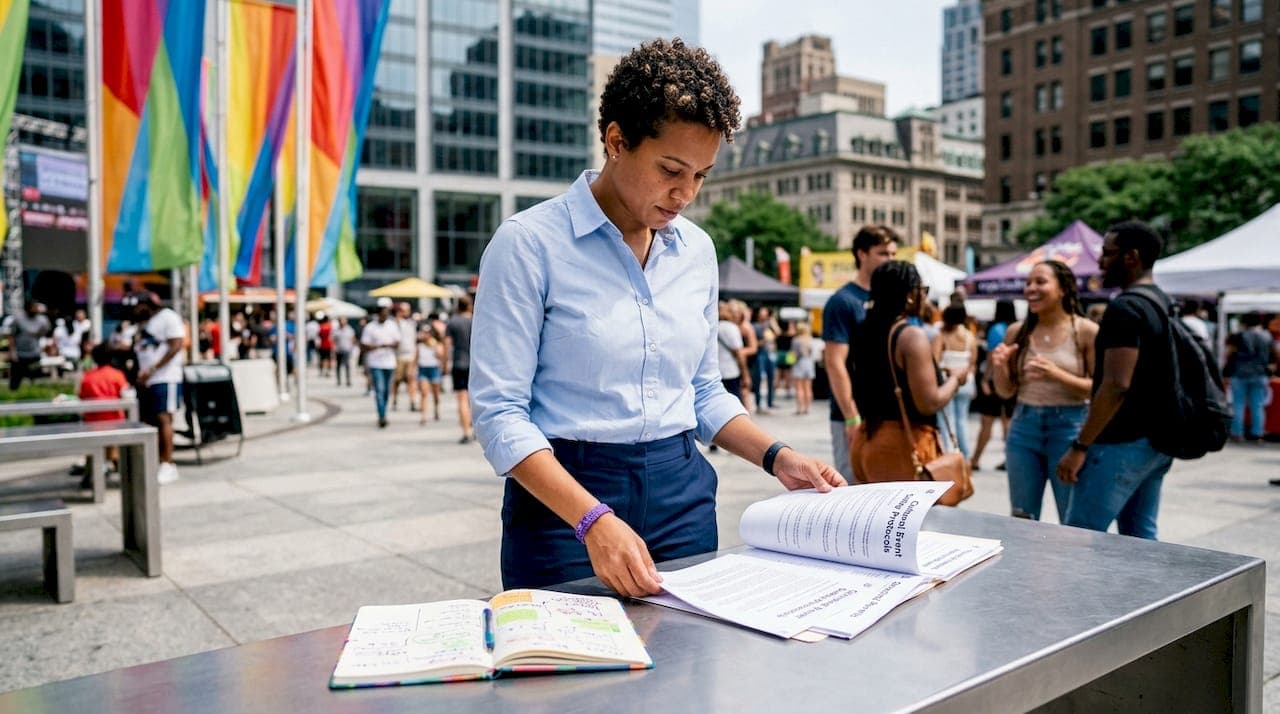
Cultural event safety best practices are the protocols and procedures that protect attendees, workers, and communities while keeping organizers compliant with WorkSafeBC requirements, the B.C. OHS Regulation, and municipal permit conditions. Cultural festivals, powwows, multicultural fairs, and community celebrations carry safety needs that standard workplace risk assessments often miss. Crowd behaviour, temporary structures, multilingual attendees, and ceremonial elements all create conditions that require specific planning. Organizers and safety managers in British Columbia who follow current event safety guidelines reduce liability, satisfy regulators, and give their communities the safe gatherings they deserve.
1. What permits and structural safety requirements apply to cultural events?
Temporary structures are one of the most frequently overlooked compliance areas in cultural festival safety. Under the BC Building Code, tents over 60m² or with an occupant load above 30 require a building permit from the local municipality. That threshold applies in Surrey, Vancouver, Burnaby, and across the Lower Mainland, so most mid-sized cultural event tents trigger a permit requirement before a single stake hits the ground.
Built-up stages also require permits and location approval to maintain emergency vehicle access routes. Mobile trailer stages may be exempt, but any stage with constructed decking, lighting towers, or rigging falls under BC Building Code sections 3.3 and 3.4. Organizers who assume a rented stage is automatically compliant often discover the gap during a municipal inspection.
Key structural compliance requirements include:
- Clearly marked exits with emergency lighting that meets BC Building Code minimums
- Signage in both English and, where applicable, the primary language of the community being served
- Confirmed emergency vehicle access routes submitted with the permit application
- Structural engineer sign-off for any tent or stage exceeding permit thresholds
- Pre-event municipal inspection scheduled at least two weeks before the event date
Pro Tip: Apply for structural permits at least six weeks before your event. Municipal building departments in Metro Vancouver and the Fraser Valley process commercial event permits on fixed review cycles, and late applications routinely delay approvals past the event date.
2. How to establish effective crowd management and communication
Effective crowd management depends on real-time information sharing among security personnel, medical staff, and emergency responders. Actsafe identifies a central command centre as the single most important coordination tool for large cultural events. Without one, security teams at the gate and medical staff at the treatment area operate with different pictures of what is happening on site.
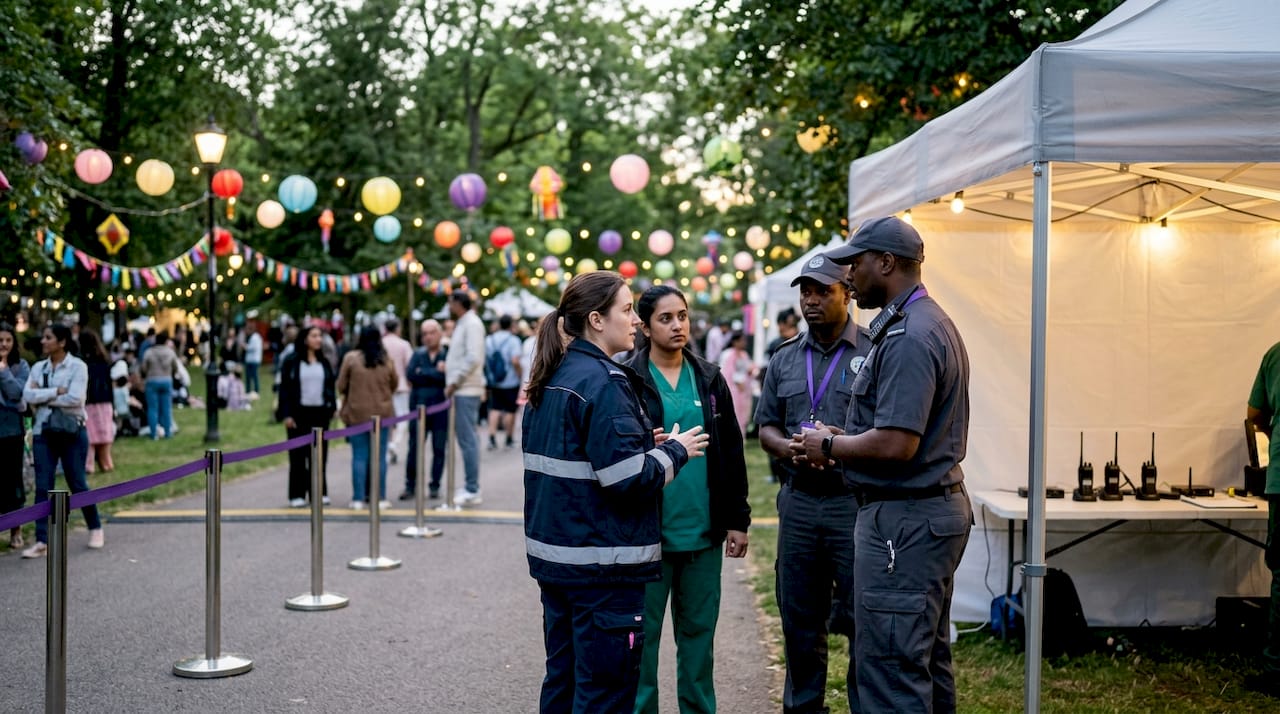
Crowd surges are most dangerous during event transitions. Transition periods, such as the end of a main performance or the opening of a new venue zone, cause sudden directional shifts in crowd movement. Modelling these transitions with emergency services before the event date is the most direct way to prevent crushing incidents.
Practical crowd management steps for cultural events:
- Conduct a detailed risk assessment at least 60 days before the event, covering site layout, expected attendance, and cultural programme timing.
- Establish a central command point with radio contact to all zone leads, medical staff, and gate supervisors.
- Design ingress and egress routes with separate entry and exit flows to prevent bottlenecks at peak arrival times.
- Use CCTV coverage at choke points and high-density zones, with a dedicated monitor at the command centre.
- Communicate crowd management rules to attendees in advance through event signage, social media, and printed programmes.
- Brief all staff on the specific cultural elements of the event, including ceremonial timing that may cause sudden crowd movement.
Pro Tip: Post bilingual crowd flow signage at every major intersection on your site. At multicultural events in Metro Vancouver, attendees who cannot read English-only signage default to following the crowd, which amplifies bottleneck risk at exits.
3. What medical support and emergency preparedness does your event need?
Medical coverage must match the risk profile of the event, not just its size. Risk-based medical scaling is the industry standard: small community cultural events require at least one trained first aid attendant on site, while large festivals with alcohol service, physical activities, or remote locations require on-site medical teams with marked treatment areas. WorkSafeBC occupational first aid requirements set the minimum, but event-specific risk factors often push the appropriate level of coverage higher.
Emergency plans must be tested, not just written. CSA Z1600 and the UN Sendai Framework both require continuous improvement of emergency management plans, including regular drills and post-event reviews. An untested plan is a liability document, not a safety tool.
Medical and emergency preparedness requirements for cultural events include:
- At least one clearly marked first aid treatment area, positioned away from high-density crowd zones
- A documented incident reporting protocol with a clear chain of command from first aid attendant to event director to emergency services
- Pre-event coordination with BC Emergency Health Services and the local fire department
- AED units placed at intervals appropriate to site size, with staff trained in their use
- A written mass casualty protocol for events exceeding 500 attendees
Organizers planning first aid coverage for small events often underestimate the documentation requirements that insurers and municipalities expect alongside the physical coverage.
Pro Tip: Confirm your medical team's WorkSafeBC certification before the event date. Certified Occupational First Aid attendants and OFA Level 3 attendants carry credentials that satisfy both WorkSafeBC requirements and municipal event permit conditions in B.C.
4. How staff training and conflict de-escalation improve event security
Security staff at cultural events face situations that standard crowd control training does not cover. The Ontario Chamber of Commerce recommends formal de-escalation training and publicly communicated house rules as the foundation of event security. De-escalation is not a soft skill. It is a measurable technique that reduces the frequency and severity of physical interventions.
House rules define the boundaries of acceptable behaviour at the event and must be communicated before attendees arrive. Posting rules at entry points, on the event website, and in the event programme removes the ambiguity that leads to confrontations. Staff who enforce rules consistently and respectfully create an environment where most attendees self-regulate.
Core training elements for cultural event security staff:
- Scenario-based role-playing covering the most common conflict situations at cultural festivals, including alcohol-related disputes, queue frustration, and cultural misunderstandings
- Clear thresholds for when verbal de-escalation ends and physical intervention or police involvement begins
- Cultural awareness briefings specific to the community hosting the event, covering communication norms and ceremonial protocols
- Professionalism standards covering tone, body language, and the consistent application of house rules across all attendee groups
- Documented post-incident reporting procedures that every security staff member completes before leaving the site
Consistency matters as much as training content. Security staff who apply rules differently based on attendee appearance or group affiliation create the conditions for confrontation, not safety.
5. Which access control strategies prevent capacity breaches?
Access control is the mechanism that keeps every other safety measure from being undermined. Unmanaged re-entry pushes events beyond safe capacity without any single visible failure point. Attendees who leave and return without being scanned out create a gap between the official count and the actual number of people on site.
The solution is a scan-in/scan-out ticketing system combined with tamper-proof wristbands for re-entry. Real-time ticket validation prevents overselling and gives the command centre an accurate live count at all times. Colour-coded credentials for different site zones prevent unauthorized access to backstage areas, performer spaces, and restricted cultural areas without requiring staff to memorize complex rules.
| Access control method | Primary benefit | Best suited for |
|---|---|---|
| Scan-in/scan-out ticketing | Accurate live capacity count | Events over 500 attendees |
| Tamper-proof wristbands | Prevents re-entry fraud | Multi-day cultural festivals |
| Colour-coded credentials | Zone access enforcement | Events with restricted areas |
| Real-time validation software | Prevents overselling | Any ticketed event |
Preventing bottlenecks at entry requires staffing entry lanes proportional to expected peak arrival times. Cultural events often have sharp arrival spikes tied to ceremonial opening times or headline performances. Modelling those spikes during planning and adding temporary entry lanes prevents the dangerous crowding that occurs when a large group arrives faster than the entry system can process them.
6. Indigenous community event safety considerations
Indigenous cultural events carry specific safety considerations that general event safety guidelines do not address. Ceremonial fires, sacred objects, restricted participation areas, and elder-led protocols all affect site layout, access control, and emergency response planning. Safety managers working on First Nations-hosted events in B.C. must engage with community leadership during the planning phase, not after the site plan is drafted.
Emergency vehicle access routes must account for ceremonial space boundaries. A route that crosses a sacred area may be technically compliant with BC Building Code requirements but unacceptable to the host community. Early dialogue with community leadership identifies these conflicts before they become day-of crises.
Medical staff assigned to Indigenous cultural events benefit from cultural safety training. BC's First Nations Health Authority provides guidance on culturally safe health service delivery that applies directly to event medical teams. First aid attendants who understand the cultural context of the event communicate more effectively with attendees and earn the trust that makes medical intervention possible when it is needed.
Collaborative planning with police, fire, and emergency services establishes unified command structures that are critical for any large event. For Indigenous events, that collaboration must include the host Nation's own safety and security representatives as equal partners in the command structure.
Key takeaways
Effective cultural event safety requires proactive compliance, scaled medical coverage, and unified command structures built before the event date.
| Point | Details |
|---|---|
| Permit thresholds are firm | Tents over 60m² or 30 occupants require a BC Building Code permit in every Lower Mainland municipality. |
| Medical coverage must match risk | Scale first aid staffing to event size, alcohol service, physical activity, and site remoteness. |
| Transitions are the highest-risk moments | Model crowd movement at performance endings and zone openings with emergency services before the event. |
| Access control protects capacity | Scan-in/scan-out systems and tamper-proof wristbands prevent capacity breaches that other safety measures cannot detect. |
| Indigenous events need tailored planning | Engage host community leadership during site planning to align emergency routes and access control with ceremonial protocols. |
What I have learned from B.C. cultural event safety planning
The shift I have seen in B.C. event safety over the past several years is real and worth naming. Organizers used to treat safety planning as a checklist completed the week before the event. The better ones now treat it as a parallel project that runs from the moment the venue is booked. That change in timing changes everything.
The hardest lesson I have seen organizers learn is that multi-agency coordination cannot be improvised on event day. Police, fire, and emergency health services each arrive with their own command language and priorities. When those agencies have not met before the event, the first serious incident becomes a coordination problem on top of an emergency. The organizers who avoid that outcome are the ones who scheduled a joint tabletop exercise two months out.
Technology adoption is accelerating, and the gap between events that use real-time crowd monitoring and those that rely on radio check-ins is widening. CCTV with a dedicated command centre monitor is no longer a luxury for large festivals. It is the minimum standard for any event where a crowd surge could occur before ground-level staff notice the problem.
The one thing I would tell every organizer in the Lower Mainland: the transition periods are where events go wrong. Plan the end of your main act as carefully as you plan the opening. Model the egress. Staff it heavily. The crowd that arrived over two hours will try to leave in twenty minutes.
— FAIR A. R.
Fairsafe supports cultural event safety in B.C.
Fairsafe provides certified first aid and safety staff to event organizers across Metro Vancouver, the Lower Mainland, and the Fraser Valley. Whether you need a single OFA Level 3 attendant for a community cultural festival or a complete event medical team for a large multi-day celebration, Fairsafe matches qualified staff to your event's specific risk profile and WorkSafeBC requirements.
Fairsafe is registered with WorkSafeBC and carries commercial general liability insurance. Our staff arrive with the credentials, equipment, and cultural awareness your event requires. Contact Fairsafe at fairsafe.ca to discuss first aid and safety coverage for your next cultural event in B.C.
FAQ
What permits does a cultural event tent require in B.C.?
Temporary tents over 60m² in floor area or with an occupant load above 30 require a building permit under the BC Building Code. Applications must be submitted to the local municipality, with emergency vehicle access routes confirmed as part of the approval.
How many first aid attendants does a cultural festival need?
The number depends on event size, risk profile, and WorkSafeBC occupational first aid requirements for the specific site. Large festivals with alcohol service or physical activities require on-site medical teams with marked treatment areas, while small community events require at least one certified first aid attendant.
What is the most dangerous moment at a cultural event?
Transition periods, particularly the end of a main performance or the opening of a new venue zone, cause the sharpest crowd surges. Actsafe identifies these moments as the highest-risk periods and recommends modelling egress scenarios with emergency services before the event date.
How does access control prevent safety incidents?
Scan-in/scan-out ticketing systems with real-time validation give the command centre an accurate live attendance count. Tamper-proof wristbands for re-entry prevent capacity breaches that occur when attendees leave and return without being counted out.
What extra steps apply to Indigenous cultural event safety?
Indigenous events require early engagement with host community leadership to align site layout, emergency access routes, and access control with ceremonial protocols. Medical staff benefit from cultural safety training, and the unified command structure should include the host Nation's own safety representatives as equal partners.