
An on-call first aid attendant in industrial settings is a trained professional who delivers immediate medical assistance on-site during every active shift, ensuring both regulatory compliance and worker safety. Under OSHA 29 CFR 1910.151(b), any worksite where emergency medical services cannot arrive within 3–4 minutes must have a certified attendant present at all times. That single requirement drives the entire staffing model for industrial first aid services. Getting it right protects your workers, limits your liability, and cuts the cost of workplace injuries significantly.
What legal requirements apply to on-call first aid attendants in industrial settings?
OSHA sets the baseline for every industrial worksite in the United States. 29 CFR 1910.151(b) requires that trained personnel and first aid supplies remain accessible within a 3–4 minute window during all work shifts. When EMS cannot meet that threshold, a certified on-call first aid attendant must be physically present on-site. This is not optional. It is an enforceable standard with real penalties.
For construction sites, OSHA 29 CFR 1926.50 mirrors this requirement and adds specific provisions for remote or multi-phase projects. Both standards define "near proximity" as that 3–4 minute EMS response time. If your site sits beyond that window, you need a certified attendant on every shift, not just during peak hours.
Supply requirements follow a parallel track. ANSI/ISEA Z308.1 defines two kit classes:
- Class A kits cover common, lower-severity injuries and suit most standard industrial environments.
- Class B kits are required for higher-hazard or remote sites where injury risk is elevated and EMS response is delayed.
Your kit class directly influences your staffing level. A Class B environment almost always requires a higher-certified attendant with advanced training in trauma response, oxygen administration, and automated external defibrillator (AED) use.
Pro Tip: Review your EMS response time data annually. Many industrial sites assume they fall within the 3–4 minute window, but actual dispatch records often tell a different story. Request documented response times from your local EMS provider and keep them on file for OSHA inspections.
WorkSafeBC adds its own layer for operations in British Columbia. WorkSafeBC mandates a minimum attendant age of 16 and requires competency certification tied directly to site-specific risk assessments. Fairsafe's certified staff meet these WorkSafeBC requirements and are deployable across Metro Vancouver industrial sites.
How do you assess your industrial worksite's first aid attendant needs?
Every industrial site has a different risk profile. A concrete plant, a chemical processing facility, and a lumber yard each carry distinct hazards, and your first aid staffing must reflect that. A structured assessment gives you a defensible, compliant answer to how many attendants you need and at what certification level.
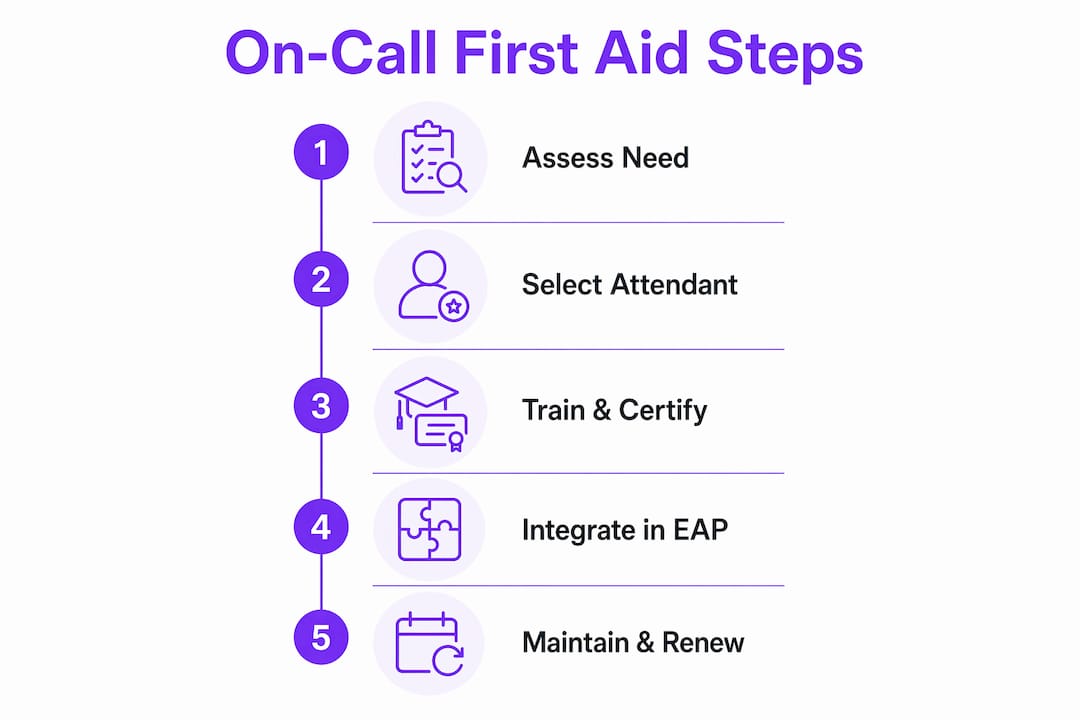
Follow these steps to build your assessment:
-
Conduct a site-specific hazard inventory. Identify every physical, chemical, and mechanical hazard present. Note which hazards carry the highest injury severity potential, such as crush injuries, chemical burns, or fall risk.
-
Map your shift structure and worker headcount. Count workers per shift, not just total employees. A site running three shifts with 80 workers each needs coverage across all three, not just during the day shift.
-
Measure your actual EMS response time. Contact your local dispatch center and request documented average response times to your site address. If the answer exceeds 3–4 minutes, you have a legal obligation to staff a certified attendant on every shift.
-
Evaluate remote location factors. Sites in industrial parks on the outskirts of Metro Vancouver or in rural areas face longer EMS delays. For guidance on remote site first aid planning, the hazard profile and isolation level together determine your minimum staffing requirement.
-
Align your training content to your hazard profile. A site with heavy machinery needs attendants trained in crush injury management and tourniquet application. A chemical facility needs training in decontamination and chemical exposure response.
Pro Tip: Do not rely on a generic risk assessment template. Build yours around the specific equipment, materials, and processes at your site. Regulators and insurers both look for site-specific documentation, not boilerplate.
How do you select, train, and maintain certified on-call first aid attendants?
Sourcing qualified attendants starts with knowing the minimum requirements. WorkSafeBC requires attendants to be at least 16 years old and hold approved competency certifications matched to the site's hazard level. In the United States, the American Heart Association (AHA) and the American Red Cross both offer recognized certifications covering CPR, AED use, and first aid fundamentals.
Key qualities and credentials to look for in an attendant include:
- Current CPR and AED certification from AHA or the American Red Cross, renewed on the required schedule.
- First aid certification level matched to site hazard class, whether basic, standard, or advanced occupational first aid.
- Familiarity with your site's specific hazards, including chemical exposure protocols, fall arrest systems, or confined space rescue procedures.
- Clear documentation of certification expiration dates and a confirmed re-training schedule before any lapse occurs.
Training format matters as much as content. In-person training produces better retention for hands-on skills like CPR, wound management, and spinal immobilization. Online hybrid programs work well for refresher content and regulatory updates, but they should never replace hands-on practice for primary certification. For a detailed breakdown of first aid certification levels required across industrial and construction environments, the differences between basic and advanced occupational programs are significant.
| Training Type | Best Use Case | Renewal Frequency |
|---|---|---|
| In-person primary certification | Initial qualification for all attendants | Every 2–3 years |
| Online hybrid refresher | Annual regulatory updates and knowledge checks | Annually |
| Scenario-based simulation | High-hazard sites with complex trauma risk | Every 1–2 years |
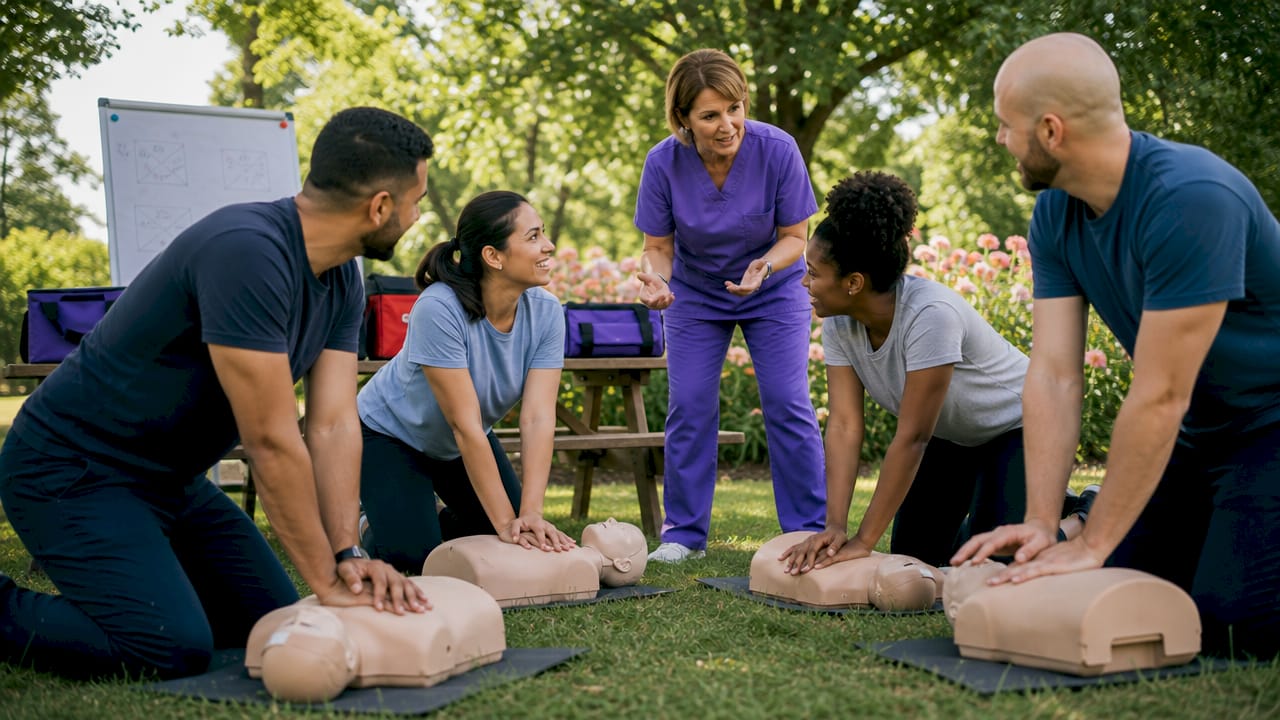
Integrate your attendants into your Emergency Action Plan (EAP). Every attendant should know the site's evacuation routes, communication protocols, and the chain of command during a medical emergency. An attendant who holds a valid certificate but has never practiced the site's EAP is a compliance checkbox, not a safety asset.
What are the best practices for an effective on-call first aid attendant system?
Running an effective on-call system requires more than placing a certified person on each shift. The operational structure around that person determines whether your emergency medical response actually works when it matters.
Shift coverage with built-in buffers. Never schedule exactly one attendant per shift with no backup. Absenteeism, training days, and vacation create gaps. Build a coverage buffer of at least one additional trained worker per shift who can step in during absences. For guidance on industrial safety deployment, coverage redundancy is one of the most commonly overlooked gaps in industrial first aid programs.
On-site triage versus emergency room costs. Effective on-site medical programs resolve injuries at approximately $502 per incident compared to $6,000 or more for emergency room visits. That cost difference alone justifies the investment in a properly staffed and equipped on-site first aid program. The math is straightforward: one avoided ER visit per month covers a significant portion of your annual attendant staffing cost.
Virtual physician integration. Some industrial operators now pair on-site attendants with virtual physician platforms. The attendant handles immediate triage and stabilization. A remote physician then guides treatment decisions in real time. This model works well for sites that need clinical oversight without the cost of a full-time occupational health nurse.
Managed compliance outsourcing for supplies and documentation. Outsourcing compliance management removes the administrative burden of first aid inventory tracking, inspection scheduling, and documentation from your internal team. It does not, however, replace the need for a certified attendant on-site. These are two separate functions. Compliance outsourcing manages your kits and paperwork. Your attendant manages the human response.
Pro Tip: Track incident response times internally, not just for OSHA reporting. If your attendant consistently takes more than 2 minutes to reach an injured worker, your coverage layout has a gap. Response time data is your best diagnostic tool for improving the system.
- Monitor and document every first aid incident, including near-misses, to identify injury patterns before they escalate.
- Conduct quarterly equipment checks on all AEDs, oxygen kits, and Class B first aid supplies.
- Review your EAP with all attendants at least twice per year, including a timed drill.
Key Takeaways
A certified, on-call first aid attendant is a legal requirement and a cost-control tool for any industrial site where EMS response exceeds 3–4 minutes.
| Point | Details |
|---|---|
| OSHA compliance threshold | Sites beyond 3–4 minutes EMS response must have a certified attendant on every shift. |
| Kit class drives staffing level | ANSI/ISEA Z308.1 Class B environments require higher-certified attendants with advanced trauma training. |
| Assessment before staffing | Conduct a site-specific hazard inventory and measure actual EMS response times before setting headcount. |
| Cost savings are measurable | On-site triage resolves injuries at roughly $502 versus $6,000 or more for ER visits. |
| Compliance outsourcing is not staffing | Managing kits and documentation is a separate function from having a trained attendant physically present. |
Why I think most industrial sites underestimate this role
Most safety coordinators I have worked with treat the on-call first aid attendant position as a compliance checkbox. They hire to the minimum standard, track the certification expiration date, and move on. That approach misses the real value of the role.
Staff tenure and stability in on-site medical roles directly improve injury prevention outcomes. An attendant who has worked your site for two or three years knows which workers push through pain, which machines generate the most near-misses, and where the blind spots in your EAP actually are. That institutional knowledge does not show up on a certification card, but it shows up in your incident rate.
The second mistake I see consistently is confusing compliance outsourcing with clinical staffing. Outsourcing your kit inspections and documentation is genuinely useful. It frees your safety team from manual regulatory tasks. But it does not put a trained human being next to an injured worker in the first 60 seconds. Those are two completely different services, and conflating them creates a dangerous gap.
The sites that get this right treat their attendants as a core part of the safety team, not a vendor. They invest in scenario training, integrate attendants into pre-shift briefings, and track response times the same way they track production metrics. The result is a workforce that feels protected and a safety record that reflects it.
— FAIR A. R.
Fairsafe's certified first aid attendant services for industrial sites
Industrial managers across Metro Vancouver trust Fairsafe to provide certified, WorkSafeBC-compliant first aid attendants for worksites of every size and hazard level.
Fairsafe deploys trained attendants rapidly, with transparent pricing that makes professional safety coverage accessible without budget surprises. Whether your site runs one shift or around the clock, Fairsafe matches attendant certification levels to your specific hazard profile and headcount. Compliance documentation, AED readiness, and shift coverage planning are all part of the service. Clients like the Musqueam Indian Band have relied on Fairsafe for dependable, affordable safety coverage. Contact Fairsafe's industrial first aid team to discuss your site's requirements and get a clear, fair quote.
FAQ
What does an on-call first aid attendant do on an industrial site?
An on-call first aid attendant provides immediate medical response to injuries and emergencies during every active shift. Their duties include wound care, CPR, AED use, and stabilizing injured workers until EMS arrives.
How many first aid attendants does my industrial site need?
The number depends on your shift structure, worker headcount, site hazard level, and EMS response time. OSHA requires at least one certified attendant per shift when EMS cannot reach your site within 3–4 minutes.
What certifications must an industrial first aid attendant hold?
Attendants must hold current CPR and first aid certifications from recognized bodies such as the American Heart Association or the American Red Cross. WorkSafeBC additionally requires competency certification matched to the site's specific hazard class.
Is compliance outsourcing the same as hiring a first aid attendant?
No. Compliance outsourcing manages first aid kit inventory and regulatory documentation. It does not provide a trained person on-site to respond to injuries. Both functions are necessary but serve entirely different purposes.
How often must industrial first aid certifications be renewed?
Primary certifications typically require renewal every 2–3 years, depending on the certifying body and the jurisdiction. Annual refresher training is recommended for high-hazard sites to maintain skill retention between full recertification cycles.