
First aid is a legal obligation in British Columbia, not a best practice. Under Section 3.16 of the OHS Regulation, every employer must provide the attendants, equipment, facilities, and transport services required by Schedule 3-A, plus any additional measures their site-specific risk assessment identifies. The role of first aid in workplace law is straightforward: no compliant first aid plan, no legal protection.
Your minimum legal obligations under WorkSafeBC include:
- Certified attendants at the level Schedule 3-A specifies for your hazard rating, worker count, and distance to medical aid
- Equipment, supplies, and facilities meeting the minimums updated as of November 1, 2024
- Prompt transport arrangements, including pre-arranged aircraft and communications for remote sites
- A written first-aid assessment documenting both the Schedule 3-A minimums and any site-specific additions
- Records retained for at least three years, accessible only to those with a legitimate need
Table of Contents
- What does B.C. law actually require under Schedule 3-A?
- Who is legally responsible when a prime contractor coordinates first aid?
- How do you verify first aid certificates and on-site compliance?
- When should you update your written first-aid assessment?
- How does temporary first-aid coverage fit into WorkSafeBC compliance?
- What should you verify before hiring a First Aid Temp Agency?
- Three scenarios where temp first-aid coverage applies in practice
- Key takeaways
- What the compliance gap really looks like on the ground
- Fairsafe: compliant first-aid temp staffing across B.C.
- Useful sources for B.C. employers
What does B.C. law actually require under Schedule 3-A?
Section 3.16(1) sets a two-part duty. Part (a) establishes the mandatory minimums from Schedule 3-A, determined by three factors: your workplace hazard rating, the number of workers present during a typical shift (including managers and supervisors), and the class of workplace. Part (b) requires a separate, site-specific evaluation of any unique circumstances that could demand a higher level of service than the table minimums.
Attendant certification levels, renamed as of November 1, 2024, now align with Canadian Standards Association (CSA) terminology:
- Basic first aid (formerly OFA Level 1)
- Intermediate first aid (formerly OFA Level 2)
- Advanced first aid (formerly OFA Level 3), with a transportation endorsement where required
Certificates issued before November 1, 2024 remain valid until their expiry date. Only a WorkSafeBC-approved training provider may issue certificates WorkSafeBC will recognise. Attendants must also be at least the minimum age specified in the regulation and hold a certificate in good standing at the time of assignment.
WorkSafeBC trust signal: Amendments effective November 1, 2024 updated minimum requirements for supplies, equipment, and facilities. Review your written assessment against the current Schedule 3-A to confirm your site still meets the regulatory floor.
Employers are also responsible for transport costs and must pre-arrange appropriate transport, including aircraft and communications, where the site's location demands it.
Who is legally responsible when a prime contractor coordinates first aid?
The short answer: you are, for your own workers. WorkSafeBC is clear that prime contractors may coordinate site-wide first aid, but each employer retains ultimate legal responsibility for the workers they employ. Assuming the prime contractor's arrangement is adequate, without verifying it, is a compliance gap.
When relying on a prime-contractor arrangement, verify the following before work begins:
- Confirm the site-wide first-aid plan covers your workers' specific work areas and hazard exposures
- Obtain written confirmation of the attendant's certification level, provider name, and certificate expiry
- Verify the attendant can reach your workers within the required response window
- Document your verification in writing and keep it in your first-aid folder
Pro Tip: Request a copy of the prime contractor's written first-aid assessment and cross-reference it against your own hazard rating and worker count. A verbal assurance that "first aid is covered on site" does not satisfy your legal duty under Section 3.16.
How do you verify first aid certificates and on-site compliance?

Confirm a certificate is valid and issued by a WorkSafeBC-approved provider before assigning any first-aid duties. This applies equally to permanent staff and temp workers supplied by a First Aid Temp Agency.
Collect these documents before the attendant starts:
- Copy of the first-aid certificate (level, issue date, expiry date)
- Name of the issuing training provider and confirmation it is WorkSafeBC-approved
- Government-issued photo ID
- Proof of any transportation endorsement if the role requires it
- Agency's commercial general liability and professional liability insurance certificates
- Signed agency agreement confirming coverage terms
When hiring through a First Aid Temp Agency, ask:
- Is the attendant's certificate issued by a WorkSafeBC-approved provider?
- What is the certificate's expiry date, and will it remain valid for the full assignment?
- Can the attendant be dedicated to first-aid duties without secondary task assignments?
- What is your substitute guarantee if the assigned attendant cannot attend?
For recordkeeping, file all of the above in a dedicated first-aid folder. WorkSafeBC requires records to be retained for at least three years and accessible only to those with a legitimate need to review them.
When should you update your written first-aid assessment?
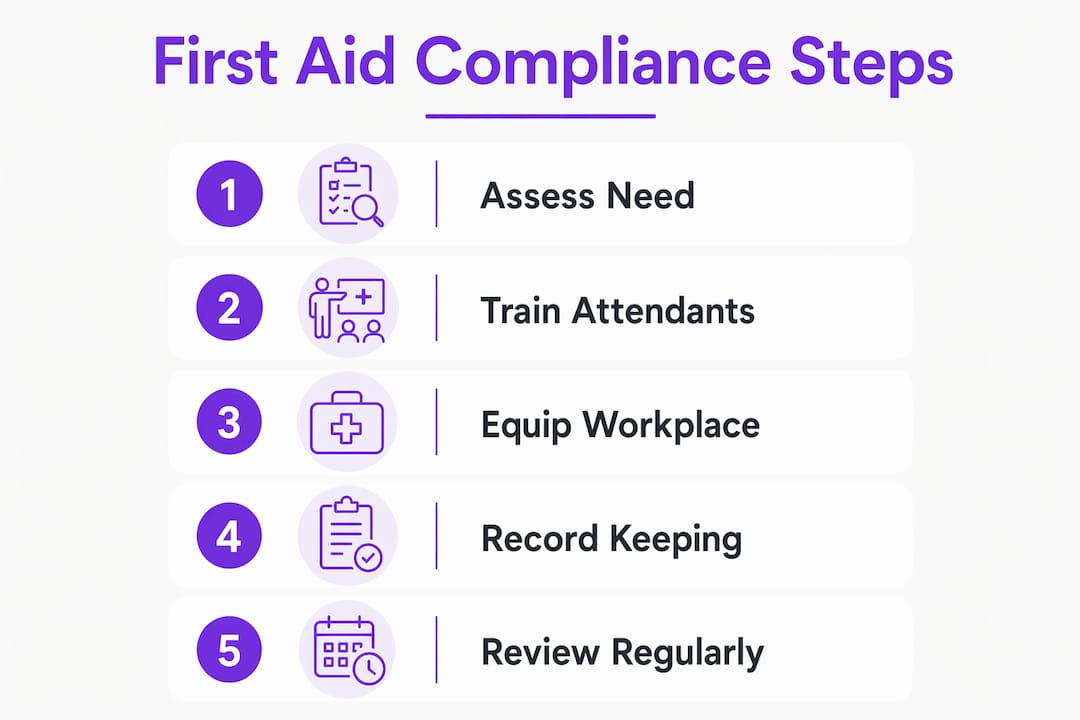
Your written assessment is a living document. WorkSafeBC requires a review at least every 12 months and whenever a significant change occurs. Waiting for the annual cycle when conditions have already shifted is a compliance risk.
Reassess immediately when any of these triggers arise:
- A new phase of construction begins, changing the hazard profile or work area
- Worker numbers increase significantly, such as during a project surge or event
- New hazards are introduced (new equipment, chemicals, or work processes)
- The site becomes more remote or less accessible to emergency services
- Seasonal conditions affect response times or transport routes
- A workplace incident reveals a gap in your current plan
The review must be conducted in consultation with your joint health and safety committee or worker health and safety representative. The person responsible for first aid on site should sign off on the updated assessment, and the revised document replaces the previous version in your records. For on-site first aid in BC, keeping this document current is one of the most common gaps WorkSafeBC officers identify during inspections.
How does temporary first-aid coverage fit into WorkSafeBC compliance?
A properly vetted First Aid Temp Agency provides compliant, flexible coverage that meets WorkSafeBC requirements when the attendants are verified, dedicated to first-aid duties, and matched to the site's required certification level. Temp coverage is not a workaround; it is a legitimate staffing model that many B.C. construction companies, industrial employers, and event organisers rely on.
Common use cases for temp first-aid staff:
- Unplanned attendant absences (WorkSafeBC requires a substitute in place by the halfway point of a shift)
- Short-term projects, single-day events, or film productions
- Shift surges during peak construction seasons in Metro Vancouver and the Fraser Valley
- Remote or less-accessible worksites requiring a transportation endorsement
- Worker-working-alone coverage and seasonal outdoor events
Lead times and scheduling: For planned projects, book temp coverage at least five to ten business days in advance. During peak summer construction season or major event weekends in the Lower Mainland, availability tightens considerably. For emergency same-day coverage, a responsive First Aid Temp Agency can often place a certified attendant within hours, but this should not be your default plan.
Cost factors that typically affect pricing:
- Certification level required (advanced first aid commands a higher rate than basic)
- Shift length and whether overtime applies
- Site location and travel distance from Metro Vancouver or Abbotsford
- Number of attendants required simultaneously
- Equipment requirements (AED, oxygen, spinal equipment, transport vehicle)
For guidance on cost-effective certified staffing in B.C., matching the certification level to the Schedule 3-A requirement is the single biggest cost lever.
What should you verify before hiring a First Aid Temp Agency?
Before signing any agreement, confirm the following:
- All attendants hold certificates from a WorkSafeBC-approved training provider
- The agency carries commercial general liability and professional liability insurance
- The agency is registered with WorkSafeBC and can provide a clearance letter on request
- Attendants will be dedicated to first-aid duties and not assigned secondary tasks
- The agency can supply substitutes within a defined timeframe for unplanned absences
- References from comparable B.C. worksites or events are available
Request these contract clauses in writing:
- Coverage guarantee: the agency commits to filling the shift or providing a qualified substitute
- Substitute timeline: a named maximum response time if the primary attendant cannot attend
- Recordkeeping: the agency provides certificate copies and insurance documents before each assignment
- Site-specific fit: the agency confirms the attendant's certification level matches your Schedule 3-A requirement
Pro Tip: For high-risk shifts on construction or industrial sites, negotiate a guaranteed standby clause. This means the agency confirms a backup attendant is on call before the primary attendant's shift begins, not after an absence is reported.
Red flags to watch for: agencies that cannot name their training providers, attendants whose certificates are within 30 days of expiry, and any arrangement where the attendant is expected to perform non-first-aid duties during the shift.
For a deeper look at evaluating providers, the temp agency for OFA coverage guide covers typical agency guarantees and what separates reliable providers from unreliable ones.
Three scenarios where temp first-aid coverage applies in practice
Scenario 1: Construction surge in Surrey A general contractor in Surrey adds two additional crews for a foundation pour, pushing the worker count above the threshold for a higher attendant level under Schedule 3-A. The trigger is the workforce increase. The employer updates the written assessment, books an advanced first-aid temp through a First Aid Temp Agency for the duration of the pour, and files the attendant's certificate copy, the updated assessment, and the agency agreement in the first-aid folder.
Scenario 2: Industrial shift in Burnaby A regular OFA attendant calls in sick 90 minutes before a night shift at an industrial facility. WorkSafeBC requires a substitute to be in place by the halfway point of the shift. The safety manager contacts their First Aid Temp Agency, confirms the substitute's certification level matches the site requirement, and documents the substitution in the shift log. The substitute's certificate copy is added to the first-aid folder before the shift ends.
Scenario 3: Outdoor event in Langley An event organiser in Langley applies for a municipal permit that requires documented first-aid coverage. The organiser completes a written first-aid assessment based on expected attendance and site layout, then engages a First Aid Temp Agency to supply two certified attendants with AED units. Required documentation includes the assessment, attendant certificates, agency insurance certificates, and the equipment checklist confirmed before the event opens.
Documentation note: In all three scenarios, contemporaneous records are what demonstrate compliance during a WorkSafeBC inspection or following an incident. Write it down at the time, not after the fact.
Key takeaways
Employers in B.C. who meet their first-aid obligations under WorkSafeBC and OHS Regulation Schedule 3-A must verify credentials, maintain a current written assessment, and use a qualified First Aid Temp Agency when permanent coverage is unavailable.
| Point | Details |
|---|---|
| Legal duty under Section 3.16 | Employers must provide attendants, equipment, facilities, and transport per Schedule 3-A and their written assessment. |
| Verify before assigning duties | Confirm every attendant's certificate is valid and issued by a WorkSafeBC-approved training provider. |
| Reassess every 12 months | Update the written assessment annually and immediately when site conditions, worker numbers, or hazards change. |
| Substitutes are mandatory | A replacement attendant must be in place by the halfway point of any shift where the primary attendant is absent. |
| Fairsafe for temp coverage | Fairsafe supplies WorkSafeBC-compliant temp first-aid staff across Metro Vancouver, the Lower Mainland, and the Fraser Valley. |
What the compliance gap really looks like on the ground
Most employers understand the regulation in principle. The gap shows up in practice: a certificate that expired two weeks ago, an attendant pulled off their post to help unload materials, or a written assessment that still reflects last year's crew size. These are not edge cases. They are the most common findings during WorkSafeBC inspections on active construction sites across the Lower Mainland.
The other gap is the prime-contractor assumption. Safety managers on multi-employer sites in Coquitlam, Richmond, and Delta regularly assume that because first aid is "handled on site," their own obligation is satisfied. It is not. Your duty to your workers does not transfer to the prime contractor.
Temp coverage, used correctly, closes both gaps. A First Aid Temp Agency that verifies credentials, provides insurance documentation, and guarantees substitutes gives you a paper trail and a compliant attendant. The regulation is the floor; your written assessment and your staffing choices determine whether you actually meet it.
Fairsafe: compliant first-aid temp staffing across B.C.
When your site needs a certified first-aid temp worker fast, Fairsafe delivers. We are a WorkSafeBC-registered First Aid Temp Agency based in British Columbia, supplying advanced first-aid attendants, Emergency Medical Responders, event medics, and construction safety personnel across Metro Vancouver, the Lower Mainland, and the Fraser Valley, including Surrey, Burnaby, Richmond, Delta, Langley, Coquitlam, and Abbotsford.
Every Fairsafe temp worker arrives with a verified certificate from a WorkSafeBC-approved training provider, dedicated to first-aid duties only. We carry commercial general liability and professional liability insurance, and we can provide a WorkSafeBC clearance letter on request. Whether you need single-shift coverage for an unplanned absence or a full temp medical team for a multi-week industrial project, we match the certification level to your Schedule 3-A requirement.
Contact Fairsafe at fairsafe.ca to request a quote or discuss your site's first-aid coverage needs.
Useful sources for B.C. employers
Keep these pages bookmarked. WorkSafeBC updates its guidance regularly, and your written assessment should always reflect the current version of Schedule 3-A.
- First aid requirements overview — WorkSafeBC: the starting point for every employer's assessment
- First aid attendant certification — WorkSafeBC: approved training providers list and certificate level descriptions
- Supplies, equipment and facilities — WorkSafeBC: November 1, 2024 amendment details
- First aid attendants — WorkSafeBC: availability requirements and substitute rules
- OHS Regulation Part 3 guidelines — WorkSafeBC: full guideline text including G3.16 and G3.17
- Workers Compensation Act Regulation 296/97 Part 3 — BC Laws: the primary regulation text
- First aid regulation FAQ — WorkSafeBC: plain-language answers on prime contractor responsibilities and recent changes
- Fairsafe — First Aid and Safety Temp Agency, Vancouver BC: temp first-aid staffing for construction, industrial, and event coverage across B.C.