
Injury triage is an immediate clinical assessment performed by a registered nurse at the moment a workplace injury occurs. Using standardised medical protocols, the nurse determines the appropriate level of care, whether that means self-care at home, a walk-in clinic, a specialist referral, or the emergency room. For employers across Metro Vancouver, Surrey, Burnaby, the Fraser Valley, and beyond, getting this decision right in the first few minutes shapes the entire trajectory of a workers' compensation claim.
Here is why worksite injury triage matters for BC workplaces:
- Directs injured workers to the right care level immediately, reducing unnecessary emergency room visits
- Supports same-day injury reporting, which helps meet WorkSafeBC's 72-hour reporting requirement
- Reduces workers' compensation claim costs and litigation exposure
- Provides psychological reassurance to injured workers, building trust and supporting safety culture
- Complements on-site first aid obligations under the BC OHS Regulation without replacing them
- Fairsafe, a WorkSafeBC-registered first aid temp agency serving the Lower Mainland, supports employers in meeting these obligations through certified occupational first aid temp staffing
Table of Contents
- How injury triage works in a BC workplace setting
- Why injury triage benefits both employers and workers
- Legal and privacy requirements for injury triage in BC
- How to set up an effective injury triage programme at your worksite
- Expert insights and best practices for BC worksite triage
- Key takeaways
How injury triage works in a BC workplace setting
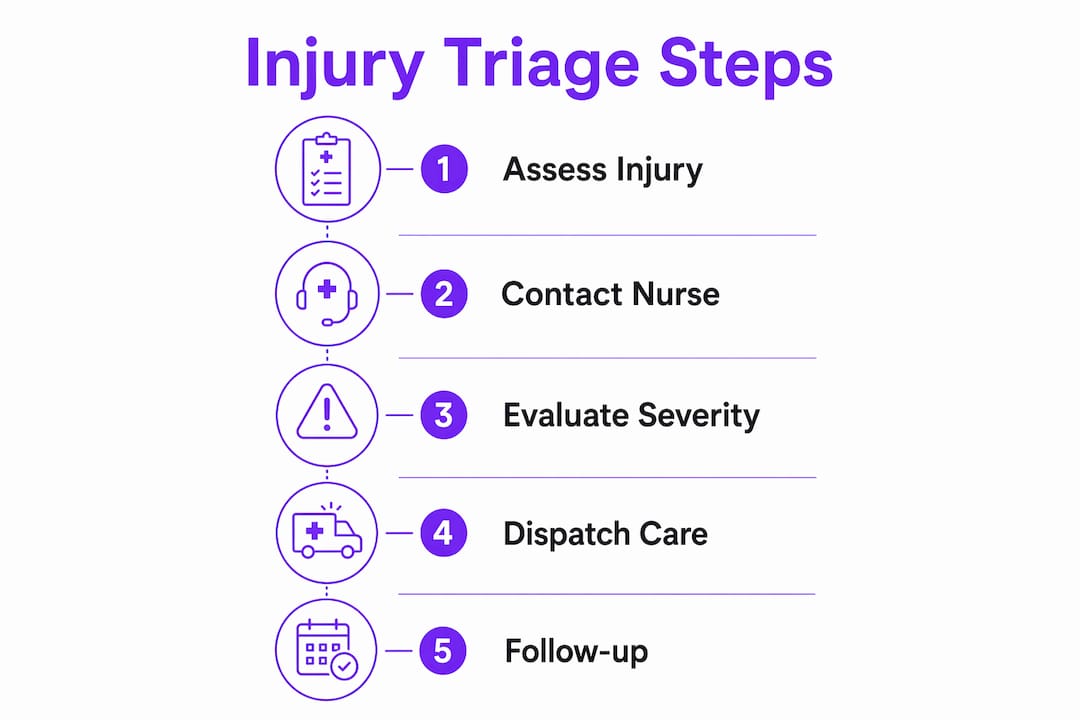
The injury triage process follows a clear, repeatable sequence. When a worksite supervisor or first aid attendant responds to an injury, the goal is to connect the injured worker with a registered nurse as quickly as possible, ideally within minutes.
Step-by-step triage workflow:
- Injury occurs and is reported to the supervisor or on-site first aid attendant, who documents the incident immediately.
- The injured worker is connected with a triage nurse, typically by phone or a dedicated app, available 24 hours a day.
- The nurse conducts a clinical assessment using evidence-based medical algorithms, gathering details about the incident, symptoms, and the worker's medical background.
- A care disposition is determined: self-care, first aid, walk-in clinic, occupational health clinic, specialist referral, or emergency room.
- An injury report is sent automatically to the supervisor, claims adjuster, HR contact, and return-to-work coordinator, enabling all parties to act without delay.
- Documentation is completed from the point of triage, creating an accurate record that supports WorkSafeBC reporting and claim management.
Types of injuries typically triaged:
- Minor soft-tissue injuries such as sprains, strains, and contusions
- Lacerations and puncture wounds
- Musculoskeletal injuries (MSIs) from lifting or repetitive motion
- Slip, trip, and fall injuries
- Eye and skin exposures to workplace substances
- Overexertion and heat-related incidents
Life-threatening emergencies, amputations, and chemical exposures bypass triage and go directly to emergency services. Triage is the first step for all other new injuries.
Technology and tools used in triage:
Nurse triage services operate through toll-free hotlines, mobile apps, and integrated case management platforms. Triage algorithms and clinical software guide nurses through structured decision trees, reducing variability and producing consistent, defensible referral decisions. Some platforms connect directly with preferred provider networks, so the injured worker is directed to a clinic already familiar with the employer's WorkSafeBC account.

Pro Tip: Train every supervisor and first aid attendant to initiate the triage call before deciding where to send the injured worker. Supervisors are not clinicians, and defaulting to the emergency room for every injury drives up claim costs unnecessarily.
Why injury triage benefits both employers and workers
The case for injury triage is both financial and human. On the employer side, the impact on workers' compensation costs is direct: fewer unnecessary claims, lower medical costs, and reduced litigation exposure. On the worker side, speaking with a nurse immediately after an injury reduces anxiety and confusion at a vulnerable moment.
Key benefits for employers and workers include:
- Faster, appropriate care: Workers receive guidance within minutes rather than waiting hours in an emergency room for a minor injury.
- Reduced ER overuse: Nurse triage hotlines channel injured workers to the most appropriate level of service, improving both costs and worker satisfaction.
- Same-day reporting: Triage nurses handle injury paperwork and facilitate prompt reporting, reducing the delays common in traditional workflows.
- Lower claim frequency: Studies show that approximately 40% of injuries routed through triage nurses are resolved with self-care, meaning no formal claim is filed.
- Shorter return-to-work timelines: Early intervention on the day of injury supports faster recovery and reduces the risk of a minor injury becoming a lost-time claim.
- Reduced litigation risk: Injured workers who receive immediate, compassionate attention are less likely to pursue legal action.
- Stronger safety culture: Providing immediate access to a nurse signals that the organisation takes worker health seriously, which reinforces trust across the workforce.
WorkSafeBC's Early Access to Physiotherapy Program aligns directly with this approach, offering sprain and strain treatment as early as the day of injury for eligible employers with active return-to-work programmes.
Legal and privacy requirements for injury triage in BC
Injury triage operates within a specific regulatory framework in British Columbia. Understanding where triage fits, and where it does not, keeps employers compliant and protected.
- 72-hour reporting obligation: BC employers must report workplace injuries to WorkSafeBC within 72 hours when a worker misses time or requires medical attention beyond first aid. Serious incidents and fatalities require immediate notification by phone to the Prevention Information Line.
- Triage does not replace incident investigation: Under the BC OHS Regulation, employers must complete a preliminary investigation within 48 hours of any injury requiring medical treatment, followed by a full investigation within 30 days. Triage is a clinical service; investigation is a separate legal obligation.
- On-site first aid requirements remain in force: Nurse triage supplements but does not replace the mandatory on-site first aid attendant coverage required under BC OHS regulations. Attendant levels are determined by worksite risk classification and location, and those requirements do not change because a triage hotline is in place.
- Confidentiality of health information: Worker health information collected during triage is subject to BC privacy legislation. Triage providers must handle personal health data in compliance with applicable privacy requirements, and employers should confirm their triage provider's data handling practices before implementation.
- Accurate documentation is an employer responsibility: The injury report generated during triage supports, but does not substitute for, the employer's own WorkSafeBC reporting obligations. Employers remain accountable for the accuracy and completeness of all submitted reports.
For a detailed overview of on-site first aid obligations in BC, the employer first aid guide covers attendant requirements, equipment standards, and reporting timelines.
How to set up an effective injury triage programme at your worksite
A well-built triage programme does not require a large budget, but it does require deliberate structure. The following steps give employers in BC a practical path to implementation.
- Partner with a certified nurse triage provider that uses evidence-based clinical protocols and employs experienced registered nurses available around the clock.
- Integrate triage into your existing OHS programme so it connects naturally with your incident reporting, return-to-work, and claims management processes.
- Train supervisors and first aid attendants to initiate the triage call immediately after any non-emergency injury, before making any referral decision themselves.
- Establish preferred provider pathways by integrating a list of local occupational health clinics into your triage provider's referral system. Consistent use of preferred providers improves care quality and claim management outcomes.
- Communicate the programme to all workers so they know what to expect when an injury occurs. Workers who understand the process are more likely to report promptly and follow through on referrals.
- Track outcomes over time: monitor self-care rates, ER referral rates, claim frequency, and return-to-work timelines to measure the programme's effectiveness and identify gaps.
- Use workplace safety technology where it fits. Platforms like WorkSafeAgent offer compliance tools that can complement your triage and documentation workflows.
For construction sites, industrial projects, and events across the Lower Mainland and Fraser Valley, Fairsafe provides certified first aid temp workers who support your triage and emergency response protocols on the ground. Having a qualified OFA attendant on site means the first link in the triage chain is always covered.
Expert insights and best practices for BC worksite triage
The evidence on injury triage points consistently in one direction: the day of injury is the most critical window for managing outcomes. Intervening on that day, with clinical guidance rather than a supervisor's best guess, changes the trajectory of a claim.
"Nurse triage is as much a risk management and psychological reassurance tool as it is a cost-saving measure. Injured workers who speak with a nurse immediately after an incident walk away with greater peace of mind, and that trust reduces the likelihood of litigation and claim escalation."
Insight drawn from occupational health research on nurse triage and workers' compensation outcomes
Best practices that BC safety managers and occupational health professionals consistently apply:
- Use standardised triage protocols across all shifts and worksites to eliminate variability in treatment decisions. Inconsistency in triage outcomes is one of the leading drivers of unpredictable claim costs.
- Treat the day of injury as the priority window. Delayed reporting, even by a day or two, allows anxiety to escalate, ER visits to happen unnecessarily, and claims to drift out of control.
- Document everything from the first call. Accurate, timestamped records from the triage nurse support WorkSafeBC reporting, protect the employer in disputes, and give the return-to-work coordinator a clear starting point.
- Reinforce triage as a worker benefit, not a cost-control mechanism. Workers who see triage as support, rather than surveillance, engage with the process more openly and recover faster.
- Review your workplace safety culture annually. Triage effectiveness depends on a culture where workers feel safe reporting injuries promptly and honestly.
Fairsafe's certified first aid temp staff are selected to meet the specific qualifications required for each BC worksite, supporting the on-site component of your triage and emergency response plan. Whether you need OFA Level 3 attendants for a construction project in Langley or event medics in Vancouver, Fairsafe provides WorkSafeBC-compliant temp coverage that fits your schedule and site requirements.
Key takeaways
Worksite injury triage, when implemented correctly, reduces claim costs, supports WorkSafeBC compliance, and improves outcomes for injured workers from the moment an incident occurs.
| Point | Details |
|---|---|
| Triage is a clinical service | A registered nurse assesses injury severity immediately and directs workers to the appropriate level of care. |
| Day of injury is critical | Intervening on the day of injury prevents unnecessary ER visits and reduces claim escalation. |
| Approximately 40% of injuries assessed through triage nurses resolve with self-care and require no formal claim or medical visit. | |
| Triage does not replace on-site first aid | BC OHS regulations still require certified first aid attendants on site; triage supplements that coverage. |
| Reporting deadlines remain the employer's responsibility | WorkSafeBC requires injury reporting within 72 hours; triage supports but does not fulfil this obligation. |
Need certified first aid temp coverage for your BC worksite? Fairsafe provides WorkSafeBC-compliant first aid and safety temp staffing across Metro Vancouver, the Lower Mainland, and the Fraser Valley. From OFA Level 3 attendants to event medics and construction safety personnel, we match qualified temp workers to your site requirements quickly and fairly. Visit fairsafe.ca to request coverage or speak with our team about your next project.