Common examples of event safety incidents in British Columbia
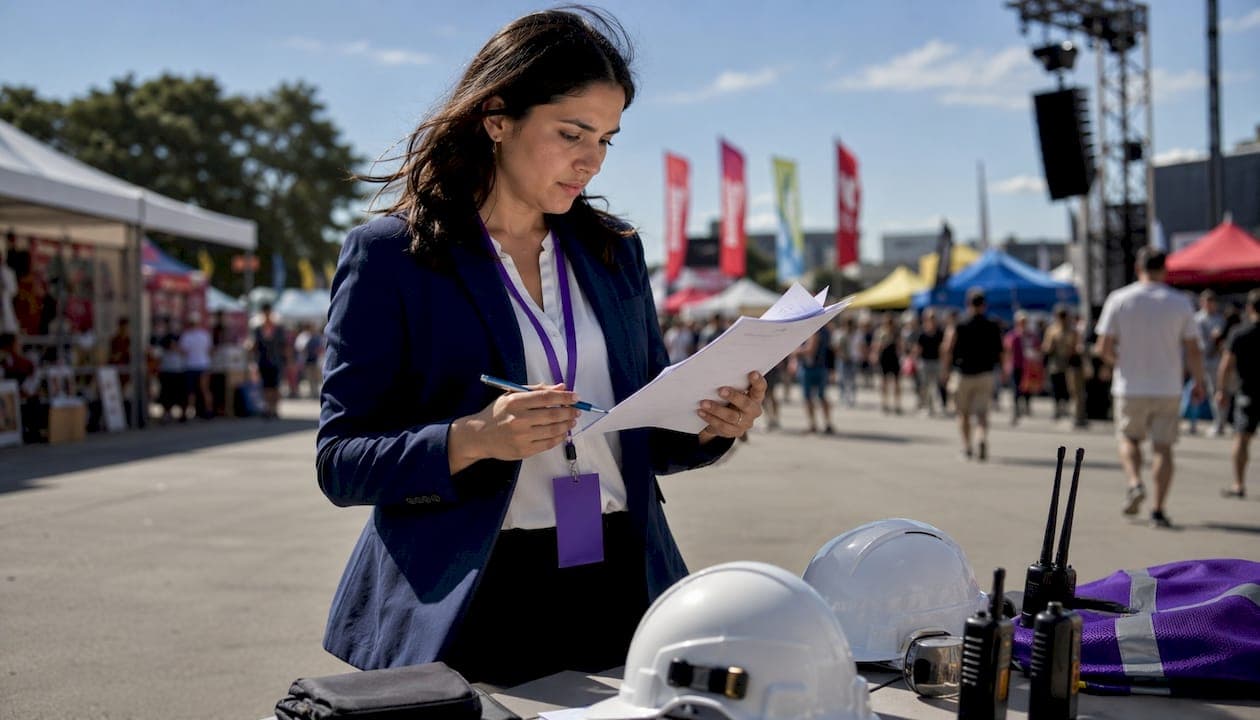
Event safety incidents in Canada fall into predictable categories, and recognising them before your event is the most reliable way to prevent them. The B.C. Public Health Guidelines for Major Planned Events classify public health consequences into heat and cold illnesses, gastrointestinal illnesses, communicable diseases, human-caused injuries, and non-human-caused injuries such as electrical storms and wildfires. That framework gives organizers a practical starting point for any risk assessment.
Recent B.C. incidents make these categories concrete:
- Physical infrastructure failure: A 2023 WorkSafeBC investigation found that a guardrail collapse at a Vancouver UFC event resulted from security staff being deployed to manage talent rather than spectator safety, a direct training and role-assignment failure.
- Hostile vehicle attacks: In 2025, a vehicle drove into the Pacific Coliseum during a Cirque du Soleil performance in Vancouver. The B.C. Study Commission on Community Events Safety documented this and multiple other hostile vehicle incidents worldwide following the April 26, 2025 Lapu-Lapu Celebration tragedy in South Vancouver, which killed eleven people.
- Medical emergencies: Heat illness, drug overdose, and alcohol-related harm are among the most frequent medical calls at outdoor festivals across Metro Vancouver and the Fraser Valley.
- Crowd surge and crushing: Large concentrations of people in limited spaces create pressure points that can escalate quickly, particularly at entry and exit pinch points.
- Hazardous substance events: Foodborne illness, water contamination, and drug-facilitated harm all appear in B.C. event incident records.
- Security breaches: Assault, civil unrest, and drug-facilitated sexual assault are documented risks at events where alcohol and other substances are present.
Understanding these categories is not just useful background. Each one demands a specific response plan, trained personnel, and clear accountability before the first attendee arrives.
Who is responsible for what during an event emergency?
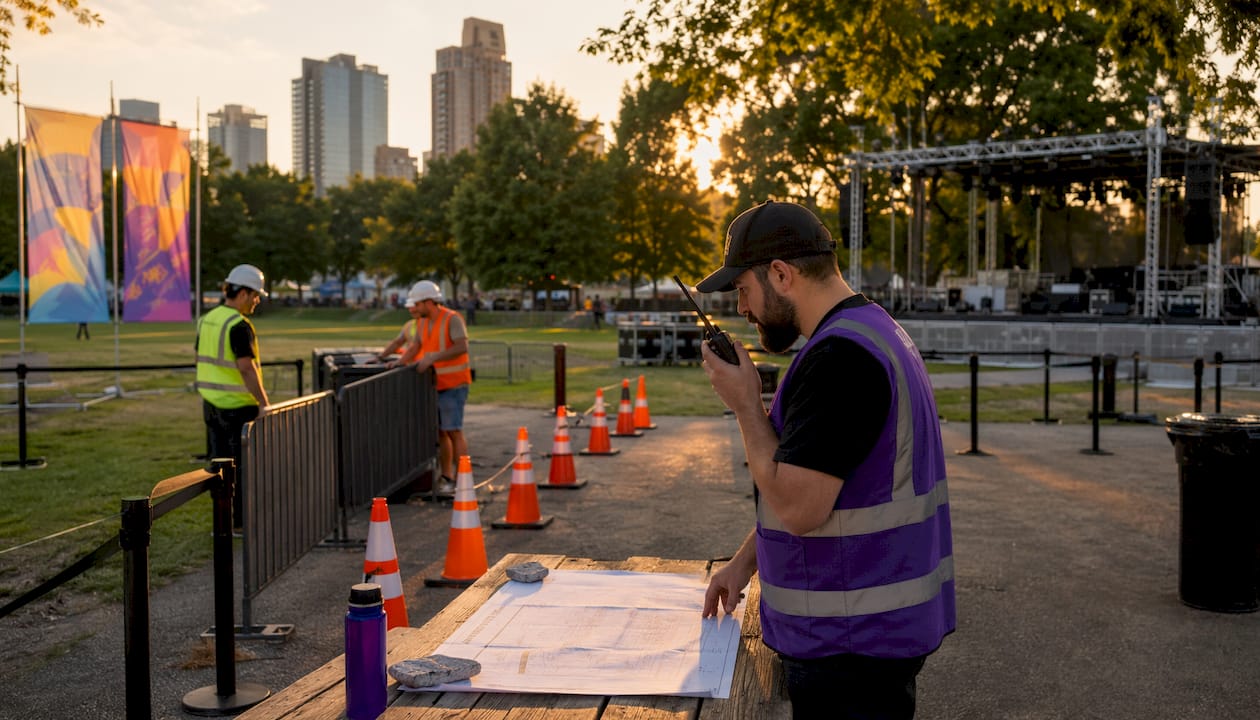
Clear role assignment is the single most common gap WorkSafeBC investigators find after event incidents. Under the B.C. OHS Regulation, the employer (typically the event organiser) retains legal responsibility for worker and public safety, even when contractors are on site. Assuming a security firm or catering company covers all liabilities is a documented and costly error.
| Role | Core responsibilities |
|---|---|
| Event organiser | Overall duty of care, emergency plan approval, regulatory compliance |
| Safety officer | Hazard identification, risk assessment, liaison with emergency services |
| Security personnel | Crowd control, perimeter management, hostile vehicle response |
| Occupational First Aid (OFA) attendant | On-site medical response, triage, coordination with BC Ambulance |
| Emergency warden | Evacuation coordination, headcounts, communication with command |
| Communications lead | Public announcements, agency notifications, incident logging |
Key responsibilities across all roles include:
- Attending pre-event briefings and reviewing the written emergency plan
- Knowing evacuation routes, assembly points, and shelter-in-place procedures
- Maintaining radio or phone contact with the event command centre throughout
- Documenting every incident, near-miss, and intervention in real time
- Deferring to the incident commander once an emergency is declared
The role of safety officers at events in B.C. is defined not just by function but by qualification. WorkSafeBC expects safety officers to hold credentials appropriate to the hazard level of the event, and that expectation applies to every contracted worker on your team.
How to report a safety incident at a B.C. event
Incident reporting is a legal obligation under the B.C. OHS Regulation, not an administrative afterthought. BC Reg. 178/2024 requires employers to have written emergency plans for workplaces involving hazardous substances, and those plans must include notification procedures for serious injuries, deaths, and significant changes in workplace conditions.
Follow these steps after any incident:
- Secure the scene. Prevent further harm and restrict access to the affected area immediately.
- Provide first aid. Activate your on-site medical team and call BC Ambulance if the injury is serious.
- Notify WorkSafeBC. Serious injuries, fatalities, and dangerous occurrences must be reported to WorkSafeBC by phone as soon as possible. Do not disturb the scene of a fatality without Coroner or WorkSafeBC approval.
- Document the incident. Record the time, location, type of incident, persons involved, witnesses, response actions taken, and any equipment or substances implicated.
- Preserve evidence. Retain CCTV footage, radio logs, and written records. These are critical for any WorkSafeBC investigation.
- Complete a written incident report. File this within the timeline required by your event safety plan and WorkSafeBC guidelines.
- Conduct a post-incident review. Identify root causes and update your hazard assessment and emergency plan before the next event.
Procedural guidelines for specific emergencies at events
No two emergencies unfold identically, but having a written procedure for each scenario removes hesitation when seconds count. The B.C. Major Planned Events Guidelines recommend organising your emergency plan by hazard type, which maps directly to the procedures below.
| Emergency type | Immediate actions | Key contacts |
|---|---|---|
| Fire | Activate alarm, evacuate, call 911, account for all persons | Local fire department, event warden |
| Crowd surge | Halt crowd movement, open additional exits, call for medical support | Security lead, OFA attendant, BC Ambulance |
| Medical emergency | Activate OFA attendant, clear space, deploy AED if cardiac arrest | OFA attendant, BC Ambulance |
| Hostile vehicle attack | Shelter in place or evacuate away from vehicle path, call 911 | VPD or local RCMP, event security |
| Severe weather | Monitor Environment and Climate Change Canada alerts, evacuate exposed areas | Event communications lead, local emergency management |
Key actions by scenario:
- Fire: Never re-enter a building once evacuated. Designate a fire warden for each zone and confirm headcounts at assembly points.
- Crowd surge: Train security to recognise early warning signs, including swaying, screaming, and people being lifted off their feet.
- Medical emergency: Your OFA attendant should have direct radio contact with the event command centre and a clear path to the nearest ambulance access point.
- Hostile vehicle attack: Physical barriers such as bollards and jersey barriers are the primary mitigation. Procedures must account for both intentional and accidental vehicle incursions.
- Severe weather: Check Environment and Climate Change Canada forecasts in the 72 hours before your event and build weather triggers into your cancellation or shelter plan.
Pro Tip: Run a tabletop drill with your full emergency team at least two weeks before the event. Walk through each scenario, identify communication gaps, and update your written plan before the event date. WorkSafeBC's own guidance under BC Reg. 178/2024 requires drills for workplaces with hazardous substance risks, and the same discipline applies to any large public gathering.
How to identify and manage hazards during event planning
Hazard identification belongs at the design stage, not the week before doors open. WorkSafeBC's emergency planning guidance is explicit: as an employer, you are responsible for assessing every potential emergency that could affect workers and attendees, including environmental hazards specific to your region.
Common hazards at B.C. events include:
- Structural risks: temporary stages, grandstands, fencing, and overhead rigging
- Environmental risks: wildfire smoke, extreme heat, flooding, and seismic activity
- Crowd risks: pinch points at entry and exit, alcohol-related behaviour, and crowd density
- Security risks: hostile vehicle access, perimeter breaches, and civil unrest
- Substance risks: drug overdose, foodborne illness, and water contamination
The B.C. Major Planned Events Guidelines recommend classifying each identified risk as high, medium, or low, then applying mitigation in this order:
- Remove the hazard entirely where possible
- Guard or barrier the hazard to prevent access
- Implement procedures to reduce exposure
- Provide personal protective equipment as a last layer
Your event safety plan must be a living document. Consult your local health authority, fire department, police service, and BC Ambulance early in the planning process. Last-minute changes to venue layout, programme content, or expected attendance can introduce new hazards that bypass your original assessment entirely.
A WorkSafeBC penalty of $783,068.26 was issued following traffic management failures at the 2024 Shambhala Music Festival. That figure reflects what inadequate planning and supervision can cost an organiser under B.C. law.
How Fairsafe supports certified event safety coverage in B.C.
Certified first aid and safety coverage is not optional at events governed by WorkSafeBC. Fairsafe is a WorkSafeBC-registered temp staffing agency based in B.C., supplying certified event safety staff across Metro Vancouver, the Lower Mainland, Surrey, Burnaby, Richmond, Delta, Langley, Coquitlam, Abbotsford, and the Fraser Valley.
Fairsafe provides:
- OFA Level 1, Level 2, and Level 3 attendants certified to B.C. OHS Regulation standards
- Emergency Medical Responders and Advanced First Aid attendants for higher-risk events
- Event medics and safety officers with experience in crowd management and emergency response
- Equipment including first aid kits, AED units, oxygen equipment, spinal equipment, and patient assessment supplies
Every Fairsafe worker is selected to match the specific hazard level and regulatory requirements of your event. Fairsafe holds commercial general liability and professional liability insurance, and can provide a WorkSafeBC clearance letter on request. Whether you need a single OFA attendant for a community festival in Langley or a full medical team for a multi-day event in Vancouver, Fairsafe structures coverage around your schedule, venue, and compliance obligations.

Planning an event in B.C. and need certified first aid or safety coverage? Contact Fairsafe at fairsafe.ca to discuss your staffing requirements.
Case studies of major event safety incidents in Canada
Real incidents reveal the gap between a written plan and actual preparedness. Three B.C. cases stand out for the lessons they generated.
The 2023 Vancouver UFC guardrail collapse exposed how misaligned staff deployment creates physical danger. Security personnel were assigned to talent management rather than spectator crowd control, and the guardrail failed under crowd pressure. WorkSafeBC's investigation confirmed OHS contraventions related to training and role assignment. The employer, not the security contractor, bore regulatory responsibility.
The april 26, 2025 Lapu-Lapu Celebration tragedy in South Vancouver, where a vehicle drove into a crowd at a Filipino cultural event killing eleven people, prompted the B.C. government to establish the Study Commission of Inquiry into Community Events Safety. The Commission's June 2025 report documented the incident alongside a pattern of hostile vehicle attacks globally and in Canada, and called for physical barrier standards at street-level public events.
The 2024 Shambhala Music Festival resulted in a WorkSafeBC penalty exceeding $783,000 for traffic management failures. The case demonstrated that inadequate supervision of vehicle movement at a large outdoor event carries consequences well beyond the incident itself.
Each of these cases shares a common thread: the hazard was foreseeable, the mitigation was either absent or improperly assigned, and the regulatory and human cost was significant.
What past event safety failures actually teach us
The pattern across B.C. event incidents is consistent. Failures rarely stem from a single cause. They result from a combination of planning gaps, misassigned roles, and the assumption that contractors absorb the organiser's legal duty of care.
Three lessons stand out from the incident record:
Employer liability does not transfer to contractors. WorkSafeBC law holds the event organiser responsible for all workers and, in many contexts, attendees. Signing a contract with a security firm does not discharge your OHS obligations. The UFC guardrail case confirmed this directly.
Event creep is a documented hazard. Last-minute changes to venue layout, attendance numbers, or programme content introduce risks that bypass the original safety review. A stage added the day before, a food truck relocated to a new position, or an unexpected crowd size can each create conditions your plan never assessed.
Physical infrastructure requires qualified oversight. Temporary structures, barriers, and fencing must be inspected by someone with the training to identify load limits and failure points. Assigning that responsibility to general event staff without specific qualifications is a recurring factor in structural incident reports.
Preventative measures and safety protocols from incident analyses
The most durable safety protocols come directly from incident post-mortems, not from generic checklists. Reviewing what went wrong at the UFC event, Shambhala, and the Lapu-Lapu Celebration produces a specific set of preventative measures for B.C. organisers.
- Conduct a site-specific hazard assessment for every event, updated whenever the venue, programme, or expected attendance changes materially.
- Assign qualified personnel to physical infrastructure. Temporary stages, guardrails, and barriers need inspection by someone trained to assess structural integrity, not general security staff.
- Install physical vehicle barriers at all pedestrian-facing perimeters. The B.C. Study Commission identified bollards, jersey barriers, and water-filled barriers as the primary mitigation for hostile vehicle risk at street-level events.
- Build multi-agency consultation into your planning timeline. Contact your local fire department, police service, BC Ambulance, and health authority early. Their input changes plans in ways that post-event reviews consistently identify as having been necessary.
- Train all staff on their specific emergency roles before the event, not during it. BC Reg. 178/2024 requires drills for hazardous substance scenarios; the same discipline applies to every emergency type your plan identifies.
- Maintain a real-time incident log throughout the event. Patterns in minor incidents often signal a larger problem developing.
Legal and regulatory requirements for event safety in Canada
In B.C., event safety sits at the intersection of the Workers Compensation Act, the B.C. OHS Regulation, and municipal bylaws. There is no single federal statute that governs all aspects of public event safety, which means organizers must navigate multiple layers of obligation.
WorkSafeBC jurisdiction covers all workers at an event, including volunteers in some circumstances. The B.C. OHS Regulation requires written emergency plans, qualified first aid coverage scaled to the hazard level of the work, and documented hazard assessments. BC Reg. 178/2024 adds specific obligations for workplaces where hazardous substances are present, including written response procedures, worker training, and drills.
Municipal authorities in Metro Vancouver, Surrey, Burnaby, and other Lower Mainland cities require event permits that typically include proof of liability insurance, a site plan, a traffic management plan, and evidence of first aid coverage. The cultural event safety requirements for B.C. events also reflect provincial public health guidelines, which carry their own approval processes for food service, water supply, and sanitation.
If a death occurs at your event, the BC Coroners Service has jurisdiction. No one may move or disturb the scene without Coroner approval, and the Coroners Act applies regardless of whether the death appears accidental or criminal.
Communication strategies during event safety incidents
Communication failures amplify every other type of incident. When the UFC guardrail failed, the absence of clear communication channels between security, event management, and medical staff delayed the response. The same pattern appears in crowd surge incidents worldwide.
Your communication plan should address three distinct phases:
Before the incident: Establish radio channels, designate a communications lead, and brief all staff on escalation protocols. Every team member should know who to call and in what order when something goes wrong.
During the incident: Use plain language on all radio communications. Avoid codes that secondary responders may not know. The communications lead coordinates with BC Ambulance, police, and fire while the incident commander manages the on-site response. Public announcements must be calm, clear, and directive, telling attendees exactly what to do rather than what is happening.
After the incident: Notify WorkSafeBC as required, brief your team, and document every communication that occurred. Post-incident debriefs consistently identify radio discipline and clear command structure as the factors that separate effective responses from chaotic ones.
For events in areas with variable cell coverage, such as remote Fraser Valley sites or outdoor venues in Abbotsford and Langley, build redundancy into your communication plan. Satellite communication devices, dedicated radio frequencies, and pre-assigned runner roles are all practical options that cost far less than a failed response.
Key takeaways
Effective event safety in B.C. requires hazard identification at the planning stage, qualified personnel in clearly assigned roles, and written procedures tested before the event opens.
| Point | Details |
|---|---|
| Employer liability is non-transferable | WorkSafeBC holds the event organiser responsible even when contractors are on site. |
| Physical barriers prevent vehicle incidents | Bollards and jersey barriers are the primary mitigation for hostile vehicle risk at street-level events. |
| Shambhala penalty was $783,068.26 | WorkSafeBC issued this fine for traffic management failures at the 2024 festival. |
| Emergency plans must be living documents | Update your hazard assessment whenever venue, programme, or attendance changes materially. |
| Certified first aid coverage is a legal requirement | B.C. OHS Regulation mandates qualified first aid scaled to the hazard level of the event. |