
Close the gap now. Arrange a verified, WorkSafeBC-compliant temporary First Aid (Temp) attendant at the OFA level your written assessment requires, document the assignment, and notify your joint health and safety committee or worker Health and Safety Representative (HSR). That sequence is your legal obligation under the B.C. OHS Regulation and applies the moment your regular attendant is unavailable.
Immediate verification steps before the Temp attendant starts their shift:
- Confirm the OFA certificate level matches what your written assessment specifies (OFA 1, OFA 2, OFA 3, or Advanced).
- Check the certificate expiry date and verify photo ID in person.
- Obtain the agency's WorkSafeBC clearance letter and proof of commercial general liability and professional liability insurance.
- Confirm which equipment the Temp attendant is bringing (AED, oxygen, spinal kit) and what your site must supply.
- Record the attendant's name, OFA level, certificate number, and assignment dates in your first-aid procedures file.
Contact Fairsafe for same-day Temp OFA attendants across Metro Vancouver and the Fraser Valley. The employer remains legally responsible for first-aid coverage throughout the assignment — that duty does not transfer to the Temp agency.
Pro Tip: Keep a digital copy of your written first-aid assessment on your phone. When a gap appears, you can confirm the required OFA level and equipment list quickly, which speeds up every call you make to a First Aid Temp Agency.

Table of Contents
- What does WorkSafeBC require for first-aid coverage at your facility?
- Common compliance mistakes that create or prolong a coverage gap
- Step-by-step checklist to close a first-aid gap quickly and compliantly
- How do you vet and choose a First Aid Temp Agency in BC?
- What affects response times and costs for temporary first-aid coverage?
- What records do you need to keep for WorkSafeBC audits?
- Two sample plans: single-shift gap and multi-day outage
- Key takeaways
- What experience with urgent first-aid staffing actually teaches you
- Fairsafe covers first-aid gaps across British Columbia
- Official references and where to read the rules in full
What does WorkSafeBC require for first-aid coverage at your facility?
Section 3.16 of the OHS Regulation requires every employer to conduct a documented written first-aid assessment covering the number of workers on site, the nature and extent of hazards, the types of injuries likely to occur, barriers to first aid, and the time needed to transport an injured worker to medical treatment. That assessment determines which row of Schedule 3-A applies to your facility and, therefore, the minimum OFA certification level, supplies, facilities, and transport arrangements you must have in place.
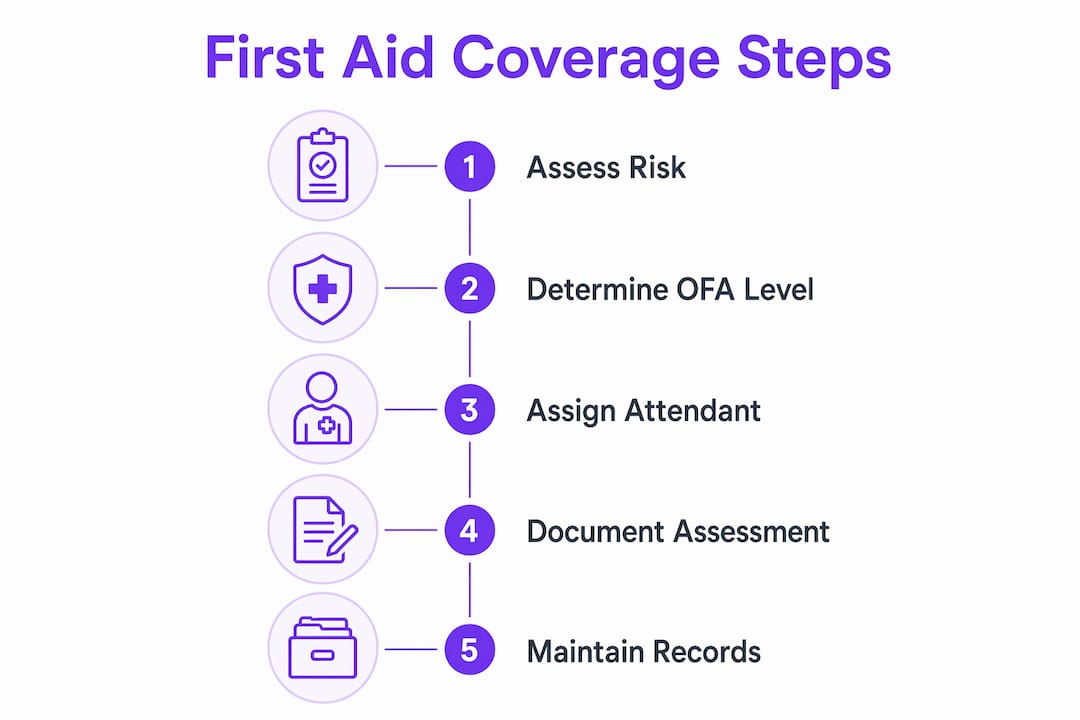
Section 3.17 adds a parallel duty: maintain up-to-date written first-aid procedures that specify equipment locations, how workers call for first aid, attendant response protocols, transport routes, and who contacts emergency services. WorkSafeBC recommends running a drill annually or whenever procedures change significantly.
Your assessment must be reviewed within 12 months or after any significant operational change. Worker consultation is also required: involve your joint committee or HSR when preparing or updating the assessment, because workers often identify barriers that management overlooks.
Remoteness matters. If BCEHS ambulance response to your site normally exceeds 30 minutes, your workplace class changes under Schedule 3-A. That typically means a higher OFA level, a transport endorsement, and possibly an Emergency Transport Vehicle (ETV).
Pro Tip: Download WorkSafeBC's Schedule 3-A worksheet and keep a completed copy with your written assessment. An inspector will ask for both.
Common compliance mistakes that create or prolong a coverage gap
Most first-aid coverage gaps at manufacturing facilities are not caused by ignorance of the rules. They are caused by shortcuts taken under time pressure.
- Substituting a lower OFA level. A lower-level OFA certificate cannot substitute for a higher one. If your assessment calls for OFA 3, an OFA 1 Temp attendant is non-compliant, regardless of how experienced that person is.
- Relying on the agency's word alone. Employers must verify credentials directly — certificate, expiry, and photo ID — not simply accept an agency's assurance.
- Assuming prime contractor coverage applies to your workers. Each employer retains non-delegable responsibility for first aid for their own workers, even on a shared site. The prime contractor's OFA attendant does not satisfy your duty unless a formal coordination agreement is documented and your written assessment confirms it.
- Ignoring physical barriers. Locked gates, multi-level floors, or blocked egress may require more than Schedule 3-A minimums. Employers must add services or equipment to mitigate delays caused by those barriers.
- Equipment gaps. Sending a Temp attendant without confirming whether your site or the agency supplies the AED, oxygen equipment, and spinal kit is a frequent audit finding.
WorkSafeBC enforcement can result in corrective orders, stop-work orders, or administrative penalties. A gap period is exactly when inspectors look hardest at your records.
Step-by-step checklist to close a first-aid gap quickly and compliantly
Immediate actions (0–2 hours)
- Pull your written first-aid assessment and confirm the required OFA level and equipment.
- Notify your joint committee or HSR that a coverage gap exists.
- Contact a First Aid Temp Agency that can supply the required OFA level — confirm availability, equipment, and WorkSafeBC clearance before booking.
Same day to 72 hours
- Verify the Temp attendant's OFA certificate (level, certificate number, expiry date) and photo ID before the shift starts.
- Obtain the agency's WorkSafeBC clearance letter and insurance certificates (commercial general liability and professional liability).
- Confirm equipment provision in writing: AED, oxygen, spinal kit, and transport endorsement if your assessment requires it.
- Record the assignment in your written first-aid procedures file.
Within 7 days
- Run a handover briefing between the Temp attendant and your permanent attendant when they return.
- Update your written assessment if site conditions changed during the gap period.
- Run a drill if procedures changed significantly, and retain the drill record.
| Timeline | Action | Owner |
|---|---|---|
| 0–2 hours | Confirm OFA level required; notify HSR; contact Temp agency | Safety manager |
| Same day | Verify credentials, clearance letter, insurance, equipment | Safety manager |
| Before shift start | Record assignment in first-aid procedures file | Safety manager |
| Within 7 days | Handover briefing; update assessment; drill if needed | Safety manager + attendant |
Pro Tip: Ask the Temp agency to email the clearance letter and insurance certificate before the attendant arrives on site. Filing them digitally the same day keeps your audit trail clean.
How do you vet and choose a First Aid Temp Agency in BC?
The right First Aid Temp Agency does more than supply a warm body with a certificate. Credential verification is your responsibility, and a reputable agency makes that easy.
Required verification — ask for these before booking:
- Current OFA certificate showing level and expiry date.
- Government-issued photo ID.
- Agency WorkSafeBC clearance letter (current, not expired).
- Commercial general liability insurance certificate.
- Professional liability insurance certificate.
Service factors to confirm:
- Response time and minimum assignment length (many agencies require a minimum of 8 hours).
- Cancellation policy and any short-notice surcharges.
- Equipment provision: AED, oxygen equipment, spinal kit, patient transport where your assessment requires it.
- Transport endorsement availability for remote or high-hazard sites.
Red flags to watch for:
- Agency cannot produce a WorkSafeBC clearance letter on request.
- Attendant cannot show a physical or digital OFA card with an expiry date.
- Vague or unverifiable insurance details.
- No written confirmation of equipment included in the assignment.
Understanding how staffing agencies fill skilled roles helps you ask sharper questions about candidate pipelines and credential checks. For BC-specific context on vetting a Safety Temp Agency, review the red flags and vetting criteria relevant to OFA assignments.
Pro Tip: Request a sample clearance letter and insurance certificate before you ever need a Temp attendant. Knowing what a valid document looks like saves time when you are under pressure.
What affects response times and costs for temporary first-aid coverage?
Booking windows vary. Same-day placements are possible with established agencies, but availability tightens on weekends, statutory holidays, and during major industrial shutdowns when demand across the Lower Mainland spikes simultaneously.
Primary cost drivers:
- OFA level required (OFA 3 and Advanced rates are higher than OFA 1).
- Travel distance and site remoteness, including any travel-time premiums for sites in Abbotsford, Langley, or beyond the Fraser Valley.
- Equipment supplied by the agency versus what your site provides.
- Transport endorsement or ETV requirement.
- Last-minute booking surcharges and cancellation terms.
Practical contracting advice:
- Get a written quote that itemises the hourly or daily rate, equipment included, travel charges, and cancellation terms.
- Confirm whether the rate covers a minimum shift length (typically 8 hours) or is purely hourly.
- Set clear invoicing terms before the assignment starts to avoid disputes.
For guidance on cost-effective certified Temp staff in BC, including how to budget for multi-day coverage, that resource covers the key variables.
Pro Tip: If you know a major maintenance shutdown or end-of-year production push is coming, pre-arrange standby Temp attendants at least two weeks out. Last-minute bookings during peak periods cost more and carry availability risk.
What records do you need to keep for WorkSafeBC audits?
Your audit file for any Temp attendant assignment should contain the following:
- Written first-aid assessment (current version and any prior versions showing update dates).
- Attendant assignment record: full name, OFA level, certificate number, expiry date, copy of certificate, photo ID confirmation, assignment dates and shift times.
- Agency WorkSafeBC clearance letter (retain the original, not just a note that you received it).
- Commercial general liability and professional liability insurance certificates.
- Incident logs and any transport records from the assignment period.
- Drill records and after-action notes when procedures changed.
WorkSafeBC provides templates to help document assessments and procedures. Use them as your baseline and add site-specific fields.
Sample attendant assignment entry:
| Field | Example |
|---|---|
| Attendant name | J. Smith |
| OFA level | OFA Level 3 |
| Certificate number | OFA3-XXXXX |
| Certificate expiry | March 15 |
| Agency | [Temp agency name] |
| WorkSafeBC clearance letter date | January 10, 2026 |
| Assignment dates | January 20–22, 2026 |
| Equipment confirmed | AED, oxygen, spinal kit |
Retain these records for the duration required under the Workers Compensation Act. Process changes, equipment additions, or increases in worker count trigger an immediate re-assessment — failing to update the written assessment is a frequent trigger for enforcement actions.
Two sample plans: single-shift gap and multi-day outage
Single-shift gap sample plan
- Confirm the required OFA level from your written assessment.
- Contact your First Aid Temp Agency; request an attendant with the correct OFA level and equipment.
- Verify certificate, expiry, photo ID, clearance letter, and insurance before the shift starts.
- Brief the Temp attendant on site layout, first-aid room location, emergency contact numbers, and transport routes.
- Record the assignment. At shift end, complete a handover note for the returning permanent attendant.
Multi-day outage sample plan
- Confirm staffing model: calculate whether one attendant covers all shifts or whether rotating Temp attendants are needed.
- Confirm transport endorsement and ETV or approved alternative transport if your assessment requires it.
- Notify the prime contractor and joint committee of the coverage arrangement and document that notification.
- Obtain clearance letters and insurance certificates for each Temp attendant before Day 1.
- Maintain a daily assignment log throughout the outage period.
- On the final day, run a handover briefing and update the written assessment if any site conditions changed.
| Plan type | Key addition vs. single shift | Documentation required |
|---|---|---|
| Single-shift gap | Handover note for returning attendant | Assignment record, clearance letter, insurance |
| Multi-day outage | Rotating attendants, transport endorsement, stakeholder notification | Per-attendant records, daily log, prime contractor notification |
Contact Fairsafe for same-day or multi-day Temp OFA attendants with WorkSafeBC clearance letters ready.
Key takeaways
Closing a first aid gap coverage issue at a manufacturing facility requires matching the Temp attendant's OFA level to your written assessment, verifying credentials directly, and filing the agency's clearance letter and insurance certificates before the shift starts.
| Point | Details |
|---|---|
| Match OFA level exactly | A lower OFA certificate cannot substitute for a higher level required by your written assessment. |
| Verify credentials yourself | Check the certificate, expiry date, and photo ID directly — do not rely on the agency's assurance alone. |
| File clearance and insurance | Retain the agency's WorkSafeBC clearance letter and insurance certificates for every Temp assignment. |
| Employer liability stays with you | Your duty of care does not transfer to the Temp agency during the assignment. |
| Fairsafe for same-day coverage | Fairsafe supplies OFA 1–3 and Advanced Temp attendants across Metro Vancouver and the Fraser Valley with WorkSafeBC clearance letters provided. |
What experience with urgent first-aid staffing actually teaches you
The paperwork gap is almost always worse than the attendant gap. In most urgent coverage situations, a qualified Temp attendant can be on site within a few hours. What takes longer is confirming that the employer has the clearance letter, insurance certificates, and assignment record filed correctly before the shift starts. Inspectors do not just check whether a certified person was present — they check whether the employer can prove it with documents.
The second lesson: short-notice bookings during major shutdowns across the Lower Mainland are genuinely competitive. Facilities in Surrey, Burnaby, and Richmond that pre-arrange standby Temp attendants before predictable outages consistently pay lower rates and avoid the scramble. Planning two weeks ahead for a scheduled maintenance window is not overcaution — it is standard practice for any facility that has been through a WorkSafeBC audit.
The third lesson is about rotating coverage on multi-day outages. Employers sometimes book one Temp attendant for a 72-hour outage and assume the person will manage. Fatigue affects clinical judgement. A rotating model with two attendants on alternating 12-hour shifts is both safer and easier to defend in an audit.
Fairsafe covers first-aid gaps across British Columbia
When your regular OFA attendant is unavailable, Fairsafe is the direct alternative to a prolonged coverage gap. As a WorkSafeBC-registered First Aid Temp Agency based in BC, Fairsafe supplies certified OFA 1, OFA 2, OFA 3, and Advanced Temp attendants for manufacturing facilities, construction sites, industrial projects, and events across Metro Vancouver, the Lower Mainland, and the Fraser Valley.
Every Fairsafe Temp attendant comes with a current OFA certificate, verified credentials, and the agency's WorkSafeBC clearance letter and insurance documentation ready to file. Depending on your site requirements, Fairsafe can also provide AED units, oxygen equipment, spinal kits, and emergency transport vehicles. Same-day placements are available for urgent gaps in Vancouver, Burnaby, Surrey, Richmond, Delta, Langley, Coquitlam, Abbotsford, and surrounding areas.
Visit fairsafe.ca to request an immediate quote or arrange a same-day Temp attendant placement.
Official references and where to read the rules in full
- OHS Regulation Part 3: Occupational First Aid (BC Laws) — the primary legislative text for Sections 3.16–3.21.
- Assess your first-aid requirements (WorkSafeBC) — written assessment guidance and Schedule 3-A worksheet.
- First-aid requirements (WorkSafeBC) — procedures, templates, and drill guidance.
- First-aid attendants (WorkSafeBC) — OFA certification levels and attendant requirements.
- OHS Guidelines for Part 3: Occupational First Aid (PDF) — detailed guidance on Schedule 3-A tables, transport endorsements, and site-specific factors.
- OFA Frequently Asked Questions (BC Employers' Advisers Office, December 2024 PDF) — practical Q&A on certification, Temp workers, and audit evidence.
- Supplies, equipment and facilities (WorkSafeBC) — minimum equipment requirements updated November 1, 2024.
- OHS Guideline G3.20: Multi-employer workplaces (WorkSafeBC) — non-delegable employer duty on shared sites.