
Why safety non-compliance is costly: the full picture
Safety non-compliance in British Columbia carries a price tag that goes well beyond a single fine. WorkSafeBC can impose administrative penalties for occupational health and safety violations, and the costs stack up fast across several categories:
- Direct financial penalties scaling by violation severity and employer size from relatively low amounts for minor violations to very high amounts for willful or repeat offences
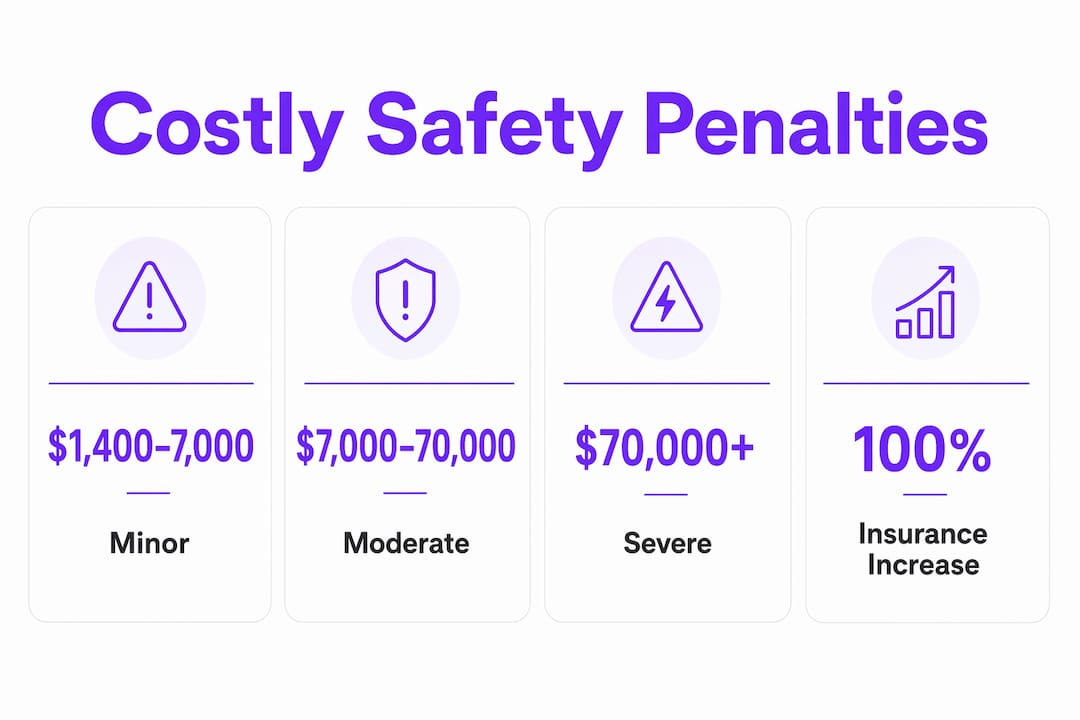
- Insurance premium surcharges of up to 100% over base rate through WorkSafeBC's experience rating system
- Stop-work orders that halt revenue while violations are corrected
- Reputational damage that limits future contract opportunities
- Legal liability including court petitions, injunctions, and director-level exposure
- Workforce disruption through reduced morale and higher turnover
Proactive safety management costs far less than reacting to penalties after an inspection.
What the financial consequences of violations actually look like

WorkSafeBC's penalty structure scales by violation severity and employer payroll size:
| Violation type | Penalty range |
|---|---|
| Minor (low risk) | $1,400–$7,000 |
| Moderate (elevated risk) | $70,000–$350,000 |
| Serious (high risk) | $70,000–$350,000 |
| Willful or repeat | $175,000–over $700,000 |
A single inspection identifying three separate violations produces three separate penalties. WorkSafeBC imposes several hundred administrative penalties annually, totalling millions of dollars across B.C.
Insurance costs compound the damage. Employers with poor safety records can see premiums increase by up to 100% through experience rating surcharges. Failing to report payroll accurately adds an 8% under-reporting penalty, and unpaid balances accrue a 1% monthly overdue charge. Losing a Certificate of Recognition (COR) removes a 10% premium discount that can represent tens of thousands of dollars annually for larger employers.
Pro Tip: Appealing even a small penalty early matters. Each subsequent penalty for the same violation within three years doubles, so a $5,000 penalty left unchallenged can grow into $35,000 across three incidents.
The due diligence defence is your strongest shield. Employers who document safety training, toolbox talks, inspections, and incident investigations can demonstrate reasonable care and avoid penalties entirely. Knowing construction safety violations specific to B.C. worksites is the first step toward building that record.
How non-compliance erodes long-term business opportunities
The financial damage from safety violations extends well past the penalty notice. General contractors and project owners across Metro Vancouver and the Fraser Valley routinely require a clean WorkSafeBC compliance record before awarding contracts. A history of violations can disqualify a firm from public tenders, municipal projects, and large private developments.
WorkSafeBC can also commence court petitions against employers and directors, seeking injunctions that can bar a company or its directors from operating in their industry. That outcome ends business entirely. Workforce turnover compounds the problem: workers who distrust a site's safety culture leave, and replacing trained personnel in skilled trades is expensive and slow.
Contractors who hire uninsured subcontractors face a separate long-term risk. Indemnity clauses alone do not protect against retroactive premium assessments. Only a WorkSafeBC clearance letter confirms a contractor is in good standing and shields you from liability for their non-compliance.
Real examples of safety non-compliance costs in British Columbia
Richmond-based Great Little Box Company received a $290,548.37 penalty after a worker was struck and killed by falling pallets. WorkSafeBC cited inadequate risk assessment, supervision, and training as contributing factors.
In a separate series of crane-related incidents at a Metro Vancouver highrise construction complex, WorkSafeBC issued three penalties totalling $1.3 million. The violations included failure to prepare written lift plans, inadequate exclusion zones, and missing risk assessments. Both the prime contractor and the concrete formwork subcontractor received separate penalties for their respective failures.
These cases share a pattern: the violations were preventable, the documentation was absent, and the costs dwarfed what a proper safety programme would have required. Qualified safety personnel on site and current first aid coverage are two of the most direct ways to close those gaps before an inspector arrives.
Fairsafe provides certified OFA attendants, construction safety personnel, and event medics across the Lower Mainland, Fraser Valley, and beyond. If you need dependable, WorkSafeBC-compliant coverage for your next project or event, contact us at fairsafe.ca.

Key takeaways
Safety non-compliance in B.C. costs employers through direct penalties, insurance surcharges, lost contracts, and legal exposure that can end a business entirely.
| Point | Details |
|---|---|
| Penalty scale | Violations range from $1,400 for minor offences to over $700,000 for willful or repeat violations, depending on severity and payroll. |
| Premium impact | Poor safety records can double WorkSafeBC premiums through experience rating surcharges. |
| Repeat violation risk | Each repeat violation within three years doubles the penalty from the previous offence. |
| COR discount loss | Losing Certificate of Recognition status removes a 10% annual premium discount. |
| Due diligence defence | Documented training, inspections, and toolbox talks can eliminate penalties entirely. |