
Hire a WorkSafeBC-registered First Aid Temp Agency that can supply the correct OFA level for your site, provide commercial general liability and professional liability insurance certificates, and integrate with your written first aid procedures. That is the short answer. To act on it now:
- Verify certificates: Confirm each attendant holds a certificate from a WorkSafeBC-approved training agency and that out-of-province credentials include a completed B.C. jurisprudence package.
- Confirm replacement coverage: WorkSafeBC requires attendants to be present during all working hours, including breaks. Ask the vendor for a documented replacement SLA covering unplanned absences.
- Request documents up front: WorkSafeBC clearance letter, CGL and professional liability insurance certificates, and individual attendant certificates before the first shift.
Contact Fairsafe for on-demand B.C. coverage across Metro Vancouver, the Fraser Valley, and beyond.
Table of Contents
- Does your vendor align with your site's incident-reporting procedures?
- Red flags that should end a vendor conversation immediately
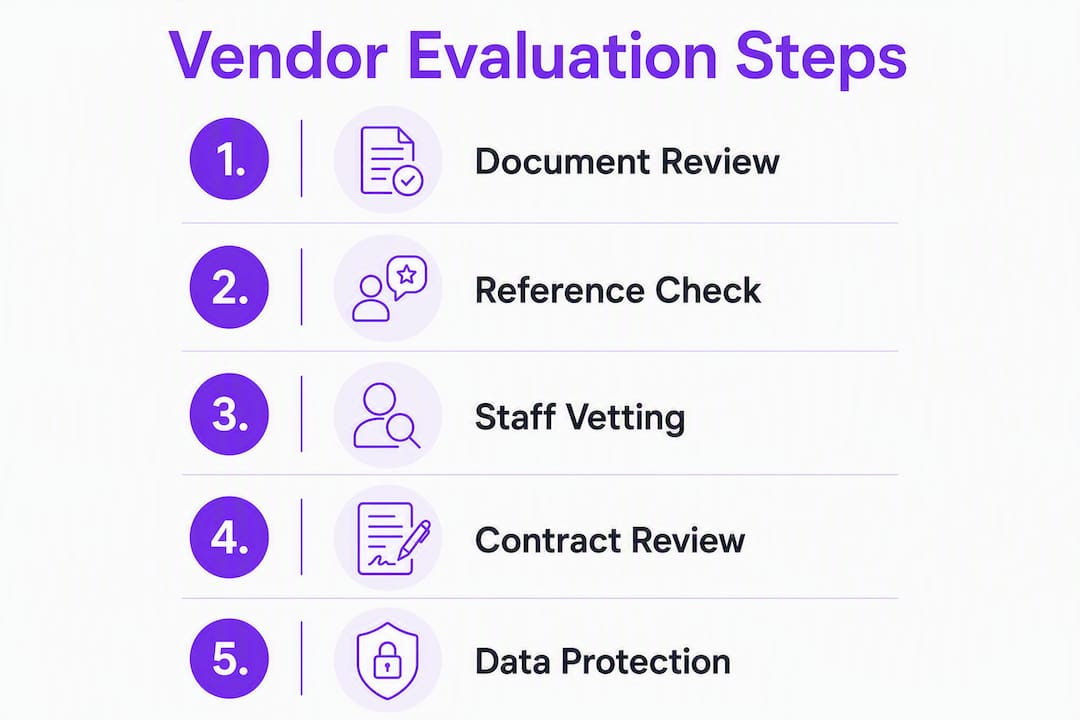
- How to verify vendor references and service reliability
- What should you know about a vendor's staff vetting process?
- Contract terms you need to review before signing
- Privacy and data protection in first aid staffing
- Key takeaways
- What a mature Safety Temp Agency actually does differently
- Booking Fairsafe for compliant temporary first-aid coverage
- Authoritative B.C. sources for vendor vetting
- The part of vendor evaluation most safety managers skip
Does your vendor align with your site's incident-reporting procedures?
WorkSafeBC requires written first aid procedures that name each attendant, state their certification level, and describe emergency transport arrangements. Your temp vendor's staff must be able to operate within those procedures from day one, not learn them on the job.
Ask every candidate vendor to confirm they will review your written procedures before the assignment starts, that their attendants can complete your incident report templates, and that they understand your communication chain for calling first aid. A vendor that requests your site's first aid procedures before quoting is demonstrating exactly the operational maturity you need. Poor documentation can trigger WorkSafeBC fines, and the legal responsibility stays with you as the employer even when staff come from a temp agency.
Pro Tip: Ask vendors whether their attendants have participated in workplace first aid drills. WorkSafeBC guidance notes that procedures should be tested via drills — a vendor whose staff have done this is far less likely to hesitate during a real incident.
Red flags that should end a vendor conversation immediately
Walk away from any vendor that cannot produce the following without delay: a current WorkSafeBC clearance letter, CGL and professional liability insurance certificates, and copies of individual attendant certificates from a WorkSafeBC-approved training agency. These are not optional documents.
Other deal breakers:
- No jurisprudence package for out-of-province certificates. A certificate from Alberta or Ontario is not automatically valid in B.C. The attendant must complete a B.C. jurisprudence package, and a professional First Aid Temp Agency manages this step before placing staff.
- Unwillingness to review your site procedures. A vendor that refuses to align with your written first aid procedures is a compliance liability.
- Vague replacement coverage. "We'll find someone" is not a replacement SLA. You need a documented process and a measurable response time.
- No incident report templates. Vendors should arrive with clear documentation tools, not improvise after an injury occurs.
How to verify vendor references and service reliability
Ask for two or three references from B.C. projects similar to yours — construction, industrial, film production, or events. Specifically ask those references whether the vendor filled last-minute shifts without gaps, whether attendants arrived with the correct OFA level for the site, and whether incident documentation was complete and timely.
For event organisers in Metro Vancouver or Surrey, ask whether the vendor has supplied staff for comparable crowd sizes and whether their attendants carried AED units and oxygen equipment on site. A vendor with a track record in your industry will answer these questions without hesitation.
What should you know about a vendor's staff vetting process?

A reliable Safety Temp Agency screens attendants beyond certificate verification. Ask directly: Do you conduct criminal record checks? How do you verify prior field experience? What is your process when a placed attendant's certificate is approaching expiry?
Vendors who maintain an internal registry of vetted, credentialed attendants can fill shifts faster and with greater confidence than those who recruit reactively. For remote B.C. worksites or multi-day construction projects in Abbotsford, Langley, or Coquitlam, that internal bench depth matters considerably.
Contract terms you need to review before signing
Your contract with a First Aid Temp Agency should address four things clearly. First, cancellation policy: what notice is required, and what fees apply for last-minute cancellations? Second, liability clauses: the contract should confirm the vendor carries professional liability insurance and that their attendants are covered under it during your assignment. Third, documentation obligations: the vendor must agree in writing to provide copies of attendant certificates, insurance certificates, incident report templates, and a process for handling out-of-province jurisprudence packages. Fourth, replacement coverage: the contract should state a measurable SLA for unplanned absences, not a best-effort commitment.
Review these terms with your legal or HR team before the first shift. Verbal assurances do not protect you during a WorkSafeBC inspection.
Privacy and data protection in first aid staffing
Incident reports contain personal health information about your workers. Your vendor must handle that information in compliance with B.C.'s Personal Information Protection Act (PIPA) and, where applicable, federal PIPEDA requirements. Ask vendors how incident records are stored, who has access, how long they are retained, and how they are destroyed.
Vendors who cannot answer these questions clearly have not built the administrative infrastructure a professional First Aid Temp Agency requires. For event first aid documentation, this is especially relevant when attendee health data is captured on site.
Key takeaways
Hire a WorkSafeBC-registered First Aid Temp Agency that supplies the correct OFA level, carries CGL and professional liability insurance, and integrates with your written site procedures before the first shift.
| Point | Details |
|---|---|
| Certificates must be WorkSafeBC-approved | Confirm each attendant's certificate comes from a WorkSafeBC-approved training agency; out-of-province certificates require a B.C. jurisprudence package. |
| Replacement SLA is non-negotiable | WorkSafeBC requires attendant coverage during all working hours; demand a documented, measurable replacement process in writing. |
| Employer liability stays with you | Even with a temp vendor on site, WorkSafeBC compliance responsibility remains yours — vet documents before the shift, not after. |
| Contract must cover four areas | Cancellation policy, liability clauses, documentation obligations, and replacement SLA must all appear in the signed agreement. |
| Fairsafe covers B.C. on demand | Fairsafe supplies WorkSafeBC-registered OFA temps with insurance, clearance letters, and staff certificates across Metro Vancouver and the Fraser Valley. |
Next steps within 24–72 hours:
- Pull your current first aid assessment and confirm the OFA level required for your site.
- Request a WorkSafeBC clearance letter, CGL and professional liability certificates, and individual attendant certificates from any vendor you are considering.
- Contact Fairsafe with your assessment summary to confirm coverage and lead times.
What a mature Safety Temp Agency actually does differently
Fairsafe treats every placement as a risk-mitigation assignment, not a shift fill. Before confirming any temp worker, Fairsafe reviews the client's first aid assessment to verify the correct OFA level and confirm whether equipment such as AED units, oxygen, or spinal boards is required for that specific site.
On a recent last-minute request from a Lower Mainland construction company, a site attendant called in sick two hours before a shift. Fairsafe placed a qualified OFA Level 3 temp on site before the halfway point of that shift, with certificates and incident report templates in hand. No compliance gap, no WorkSafeBC exposure.
For out-of-province attendants, Fairsafe manages the B.C. jurisprudence package process so employers do not carry that administrative burden. Incident reporting follows WorkSafeBC protocols, and documentation is provided to the employer at the end of each assignment. That combination of OFA level matching, replacement speed, and documentation discipline is what separates a professional First Aid Temp Agency from a staffing list.
Booking Fairsafe for compliant temporary first-aid coverage
When you contact Fairsafe, have your site assessment summary ready: maximum workers present, hazard rating, shift times, and any access or transport constraints. Fairsafe will confirm the required OFA level, provide proof of insurance and a WorkSafeBC clearance letter, and supply individual attendant certificates before the assignment begins.
For Metro Vancouver, Surrey, Burnaby, Richmond, Delta, Langley, Coquitlam, Abbotsford, and surrounding Fraser Valley areas, Fairsafe can typically confirm coverage within one business day for planned assignments. Last-minute shifts are accommodated based on availability, with replacement coverage guaranteed under a documented SLA. Visit fairsafe.ca to request coverage and provide your site details.
This article provides general information about WorkSafeBC first aid staffing requirements. Confirm current regulations and your specific obligations with WorkSafeBC or a qualified occupational health and safety professional.
Authoritative B.C. sources for vendor vetting
These WorkSafeBC and government resources should be open in your browser when you vet any First Aid Temp Agency:
| Resource | What it covers |
|---|---|
| First aid attendants — WorkSafeBC | Employer responsibilities, required OFA levels, and approved training agency list |
| Assess your first aid requirements — WorkSafeBC | Written assessment process, annual review obligations, and OFA level matching |
| First aid procedures — WorkSafeBC | Required elements for written procedures, posting requirements, and drill guidance |
| OFA FAQ — Government of B.C. | Out-of-province certificate recognition and jurisprudence package requirements |
| On-site first aid in B.C. — Fairsafe blog | Practical deployment checklists and employer obligations for B.C. worksites |
Request these documents from every vendor before signing: WorkSafeBC clearance letter, CGL and professional liability insurance certificates, individual attendant certificates, and incident report templates with a written clause covering out-of-province jurisprudence packages.
The part of vendor evaluation most safety managers skip
Most first aid supplier evaluation checklists stop at certificates and insurance. Those matter, but they are table stakes. The real differentiator is whether a vendor has built the operational infrastructure to keep you compliant when things go sideways — an attendant calls in sick at 5 AM, a WorkSafeBC officer arrives unannounced, or a remote site turns out to carry a higher hazard rating than the original assessment suggested.
A vendor that asks for your first aid assessment before quoting is not being difficult. They are doing their job. A vendor that sends a replacement before the halfway point of a shift is not going above and beyond. That is the minimum the regulation expects. The problem is that most employers only discover these gaps after a compliance lapse, not before.
Price matters, and cost-effective first aid staffing is achievable in B.C. without cutting corners on compliance. But a vendor who wins on price by skipping the jurisprudence package review, carrying no professional liability insurance, or offering a vague replacement process is not saving you money. They are transferring their risk onto you. The employer's legal responsibility under WorkSafeBC does not transfer with the staffing contract. That distinction is worth more than any per-hour savings.