
Safety is not a separate agenda item from business continuity planning. It is the foundation. If a worker is injured and no certified first aid attendant is on site, your operation stops, your liability exposure rises, and your reputation takes a hit that outlasts the incident itself. The short version: treat certified Temp first aid and safety coverage as a core continuity function, not an afterthought. Under the B.C. OHS Regulation and WorkSafeBC requirements, employers must have a health and safety program and maintain qualified first aid coverage at all times. Fairsafe is a local BC First Aid Temp Agency that helps employers and event organisers across the Lower Mainland, Fraser Valley, and beyond close that gap quickly.
Table of Contents
- Why safety must sit at the heart of business continuity
- What B.C. law requires from employers and event organisers
- What certified Temp first aid and safety personnel actually provide on site
- How to integrate Temp first aid staffing into your continuity plan
- Typical timeline, availability, and cost factors for Temp first aid staff in B.C.
- What to verify before the first shift with a Temp first aid agency
- Testing the plan and building an incident-ready culture
- Key takeaways
- A perspective on safety as a continuity priority
- Fairsafe provides on-demand Temp first aid coverage across B.C.
- Useful sources and references
Why safety must sit at the heart of business continuity
Business continuity planning is a proactive strategy to keep mission-critical services running during a disruption while protecting personnel. Safety failures are among the fastest ways to trigger that disruption.
Three continuity impacts employers consistently underestimate:
- Downtime and lost skills. A serious incident sidelines trained workers, halts production, and can shut a site for days pending a WorkSafeBC investigation.
- Legal and insurance costs. Non-compliance with first aid requirements can result in orders, fines, and increased WCB premiums that affect the business long after the incident.
- Reputational damage. Clients, subcontractors, and municipal partners notice when a site has a preventable injury. Recovery from that perception takes far longer than physical repairs.
A continuity plan focused on safety reduces risk during recovery and keeps the workforce available to support operations. Planning first aid coverage before an incident is what separates a resilient operation from one that scrambles after the fact.
What B.C. law requires from employers and event organisers
Every B.C. employer must maintain a health and safety programme. The complexity of that programme depends on workforce size and hazard level, as set out by WorkSafeBC:
- For very small workplaces, no formal committee is required, but a health and safety programme is still mandatory.
- Small workplaces require a worker health and safety representative.
- Medium to large workplaces need a Joint Health and Safety Committee and may require a formal programme depending on hazard risk.
- Large workplaces require a formal programme regardless of hazard rating.
First aid requirements are determined by a written assessment that accounts for workforce size, hazard type, site conditions, and transport times to hospital. Under amendments effective November 1, 2024, Schedule 3-A sets minimum first aid levels, and assessments must be reviewed annually and whenever workplace conditions change. Remote sites where travel to a qualifying hospital exceeds two hours may require overnight care facilities equipped for at least two injured workers. On multi-employer worksites, the prime contractor carries the duty to ensure unified first aid procedures to maintain site compliance.
What certified Temp first aid and safety personnel actually provide on site
Choose your Temp roles to match your hazard profile. The table below maps the common roles available in B.C.

| Role | Typical scope of practice | Minimum certification | Typical equipment |
|---|---|---|---|
| OFA Level 1 | Basic first aid, wound care, CPR | OFA Level 1 (BC-approved provider) | First aid kit, CPR mask |
| OFA Level 2 | Intermediate assessment, spinal care, oxygen | OFA Level 2 | Kit, oxygen, spinal board |
| OFA Level 3 | Advanced assessment, airway management, extended care | OFA Level 3 | Full kit, oxygen, AED, spinal equipment |
| Emergency Medical Responder (EMR) | Pre-hospital emergency care, patient transport | EMR certification | Advanced kit, AED, oxygen, stretcher |
| Event Medic | Crowd event medical response, triage | OFA Level 2 or higher / EMR | Mobile kit, AED, communications |
Equipment to confirm is on site or supplied by the Temp agency before the first shift:
- Automated external defibrillator (AED) units, inspected and charged
- Oxygen equipment with appropriate delivery masks
- Spinal board and cervical collars
- Fully stocked first aid kits meeting Schedule 3-A minimums
- Patient assessment supplies (blood pressure cuff, pulse oximeter, trauma dressings)
- Communications device independent of the first aid attendant if an emergency vehicle is required by your assessment
Pro Tip: For remote B.C. construction sites, confirm that any required emergency vehicle can reach the incident scene within 10 minutes and that the operator is someone other than the first aid attendant. This is a WorkSafeBC requirement, not a recommendation.
How to integrate Temp first aid staffing into your continuity plan
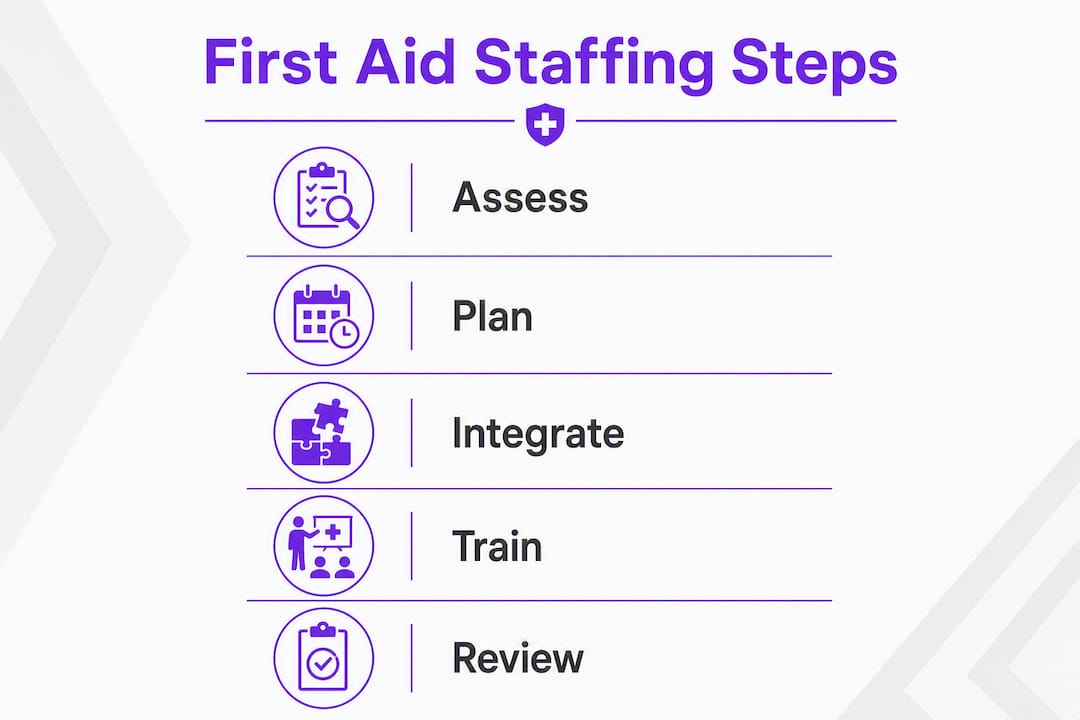
Close first aid coverage gaps in your business continuity plan by following these steps in order.
- Conduct a first aid risk assessment (1–2 days). Identify workforce size, hazard level, site type, and transport time to the nearest hospital. Update this assessment annually and at every project phase change.
- Identify coverage gaps (half a day). Compare your current first aid resources against Schedule 3-A minimums. Flag shifts, events, or remote phases with no qualified attendant on site.
- Specify Temp roles and equipment needed (1 day). Match OFA levels, EMR, or event medic requirements to each gap. Confirm whether the Temp agency supplies equipment or whether you source it separately.
- Contract with a Temp first aid agency (24–72 hours for standard roles; 2–4 weeks for remote or specialized assignments). Provide the agency with your site address, shift times, hazard profile, and any access or orientation requirements. For remote construction sites, allow additional lead time for transport logistics and overnight care planning.
- Complete site orientation and establish communication protocols (before first shift). The Temp attendant must know the site layout, emergency exits, muster points, and who to contact during an incident. Integrate them into your existing emergency response plan so there is no gap between the Temp attendant's response and your in-house team's actions.
- Maintain records. Keep first aid incident records, attendant certifications, equipment inspection logs, and drill records on file and accessible to your Joint Health and Safety Committee or worker representative.
Pro Tip: Brief your in-house workers and supervisors before a Temp attendant arrives. Confirm who calls 911, who manages the scene, and who communicates with the Temp attendant. A clear handover protocol prevents the hesitation that costs time during a real incident.
Effective continuity planning requires cross-functional involvement so that front-line safety needs and Temp staffing are included in the plan from the start, not added as an afterthought.
Typical timeline, availability, and cost factors for Temp first aid staff in B.C.
Same-day Temp coverage is possible in Metro Vancouver and the Lower Mainland, but it costs more and availability depends on certification level. OFA Level 1 and Level 2 Temps are generally easier to source on short notice than OFA Level 3 or EMR roles. For OFA Level 3 coverage, plan for at least 48–72 hours of lead time under normal conditions.
Major cost factors to account for in your budget:
- Certification level. OFA Level 3 and EMR Temps command higher rates than Level 1 or Level 2.
- Distance and remote logistics. Sites outside Metro Vancouver, or those requiring air transport access, add travel time, accommodation, and vehicle costs.
- Required equipment. If the Temp agency supplies AEDs, oxygen, or emergency vehicles, confirm whether those are included in the rate or invoiced separately.
- Shift length and last-minute call-outs. Extended shifts and same-day bookings typically carry premium rates.
To manage costs and protect availability, consider block bookings for multi-day projects, seasonal planning for peak construction periods, and low-cost first aid staffing strategies that match certification level to actual hazard requirements rather than defaulting to the highest level for every role.
What to verify before the first shift with a Temp first aid agency
Verify credentials, WorkSafeBC clearance, insurance, and site-specific competency before any Temp attendant starts work.
Before signing a contract, confirm:
- Valid OFA Level 1, 2, or 3 certifications, or EMR certification, issued by a BC-approved training provider
- A current WorkSafeBC clearance letter from the agency
- Commercial general liability insurance and professional liability insurance certificates
- Confirmation that the agency conducts site-specific orientation for each assignment
- An equipment list confirming what the Temp attendant will bring and what you must supply
- References from comparable worksites or events
Documents to keep on file:
- Copies of the Temp attendant's certifications
- Agency contract and assignment confirmation
- Insurance certificates
- Site orientation record signed by the Temp attendant
Testing the plan and building an incident-ready culture
Test integration with tabletop and practical drills at least annually and after any significant site change. Under the 2024 OHS amendments, employers must conduct drills at least once each year to confirm that workers, first aid attendants, and other designated persons can fulfil their roles.
A practical exercise schedule:
- Tabletop exercise (annually): Walk supervisors, safety leads, and the Temp agency contact through a scenario. Identify communication gaps and equipment shortfalls without stopping production.
- Functional drill (annually or after a site change): Test the actual response. Time the call to the first aid attendant, the patient assessment, and the handover to emergency services.
- Full simulation (for high-hazard or remote sites): Include emergency transport, communications, and overnight care procedures if your assessment requires them.
After each exercise, document what went well, what failed, equipment issues, communication breakdowns, and corrective actions. Update your business continuity plan and first aid assessment to reflect the findings. The PPRR model (prevention, preparedness, response, recovery) provides a useful framework for structuring these reviews and keeping staff involved in ongoing plan improvement.
Key takeaways
Certified Temp first aid coverage is a compliance requirement and a continuity asset: plan it before an incident, not after.
| Point | Details |
|---|---|
| Annual first aid assessment | Conduct and update your WorkSafeBC first aid assessment every year and at each project phase change. |
| Match Temp roles to hazards | Select OFA Level 1, 2, 3, EMR, or event medic based on your actual hazard profile and site conditions. |
| Verify agency credentials | Confirm WorkSafeBC clearance, certifications, and insurance before the first shift. |
| Plan lead times early | Standard Temp bookings take 24–72 hours; remote or specialized roles need 2–4 weeks of lead time. |
| Fairsafe for BC coverage | Fairsafe provides certified Temp first aid and safety staff across Metro Vancouver, the Lower Mainland, and the Fraser Valley with WorkSafeBC clearance and insurance on request. |
A perspective on safety as a continuity priority
The conventional view treats business continuity planning as an IT and operations exercise. Disaster recovery plans, data backups, alternate suppliers. Worker safety gets a paragraph near the end, usually under "emergency response." That ordering is backwards.
Every serious worksite incident I have seen discussed in the BC safety community follows the same pattern: the first aid coverage was assumed, not confirmed. Someone thought another employer on the multi-employer site had it covered. Or the OFA Level 3 attendant called in sick and no Temp replacement was arranged. The result is not just a human cost. It is a WorkSafeBC investigation, a stop-work order, and a project delay that no continuity plan anticipated because the plan never treated first aid staffing as a critical resource.
The practical fix is straightforward. Add certified Temp first aid coverage to your business continuity plan the same way you add backup power or a secondary supplier. Assign it a budget line, a lead time, and a verification checklist. Test it with your in-house team at least once a year. The organisations that do this do not scramble when an attendant is unavailable. They make one call and the gap is filled.
Fairsafe provides on-demand Temp first aid coverage across B.C.
When your first aid attendant is unavailable and your site cannot stop, Fairsafe is the direct alternative to a lengthy agency search. As a local BC First Aid Temp Agency, Fairsafe places certified OFA Level 1, 2, and 3 attendants, Emergency Medical Responders, and event medics across Metro Vancouver, the Lower Mainland, Surrey, Burnaby, Richmond, Delta, Langley, Coquitlam, Abbotsford, and the Fraser Valley, with no long-term commitment required.
Fairsafe holds a valid WorkSafeBC clearance letter and carries commercial general liability and professional liability insurance. Equipment including AED units, oxygen, spinal boards, and stocked first aid kits can be arranged depending on the assignment. Single shifts, multi-day projects, remote worksites, event coverage, and long-term contracts are all available.
Contact Fairsafe at fairsafe.ca to confirm availability and get a quote for your next shift or project.
Useful sources and references
The sources below are authoritative for B.C. employers building or updating a business continuity and safety plan. WorkSafeBC is the primary regulatory authority for occupational health and safety in British Columbia. The B.C. OHS Regulation is the governing legal instrument. CCOHS and the Canadian Centre for Cyber Security provide nationally recognised continuity and safety guidance.
| Source | What it covers |
|---|---|
| WorkSafeBC — Health and safety programmes | Programme thresholds, committee requirements, and hazard ratings for B.C. employers |
| WorkSafeBC — First aid requirements | First aid assessments, certifications, records, and drills |
| WorkSafeBC — Supplies, equipment and facilities | Schedule 3-A minimums, emergency vehicle requirements, overnight care |
| B.C. OHS Regulation (B.C. Reg. 296/97) | Full text of occupational health and safety requirements for B.C. workplaces |
| B.C. Reg. 132/2023 — November 2024 amendments | 2024 updates to first aid supplies, facilities, and drill requirements |
| Canadian Centre for Cyber Security — business continuity | Business continuity planning framework and cross-functional involvement guidance |
| Business Queensland — PPRR continuity model | Prevention, preparedness, response, and recovery framework for plan testing |