
What are the main construction site hazard categories under BC regulations?
Under the BC OHS Regulation, a hazard is any condition or thing that may expose a person to injury or occupational disease. On BC construction sites, hazards fall into four regulated categories:
- Fall hazards — working at elevation, unguarded edges, scaffolds, ladders
- Chemical hazards — crystalline silica, asbestos, lead, isocyanates, mould
- Physical hazards — noise, vibration, temperature extremes, electrical exposure
- Biological hazards — mould, animal droppings, sewage, confined space atmospheres
WorkSafeBC assigns hazard ratings of low, moderate, or high to classification units based on historical claims data. These ratings set a minimum baseline — they are not a substitute for site-specific assessments, which BC law requires every employer to conduct. Employers must identify, assess, and control hazards before work begins and whenever site conditions change. Temporary safety personnel from agencies like Fairsafe can help fill coverage gaps during those transitions.
Table of Contents
- How each hazard category affects your site and what you must control
- Quick summary: hazard categories and compliance priorities for BC safety managers
- Which methods and tools help you identify hazards effectively on construction sites?
- How do you report and document hazards under BC regulations?
- Key takeaways
How each hazard category affects your site and what you must control
Fall hazards
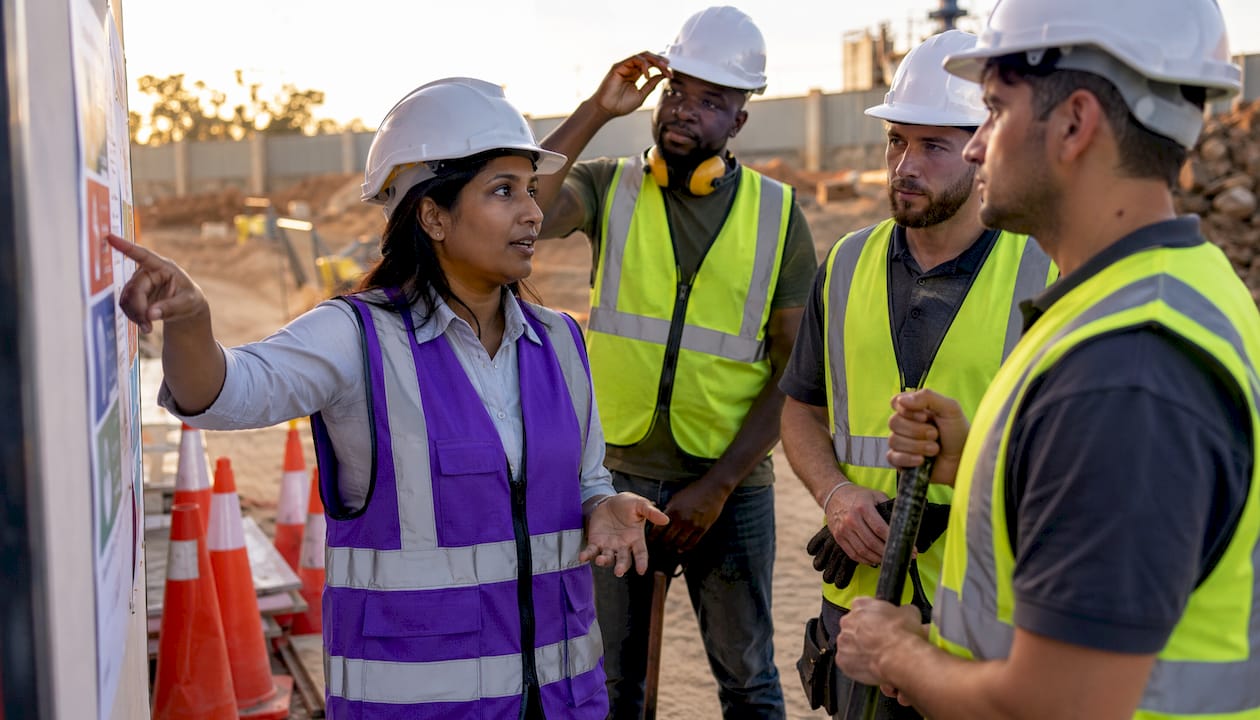
Falls from elevation are among the most serious causes of injury on BC construction sites. Fall protection is required at heights of several metres or more, but the nature of the surface below matters even at lesser heights — a fall onto rebar or concrete at a lower elevation can be fatal. Controls follow a clear hierarchy: eliminate the need to work at height, then install guardrails, then apply fall restraint, then fall arrest systems. Safe work procedures, such as three-point contact on ladders, are the last layer.
Chemical hazards
Demolition and renovation work commonly disturbs asbestos, lead, mercury, PCBs, and crystalline silica. Drilling or cutting concrete releases silica dust linked to silicosis and lung cancer. Spray foam and two-part epoxy products release isocyanates. A Notice of Project (NOP) must be submitted at least 48 hours before any moderate or high-risk asbestos work, lead disturbance, or similar occupational disease exposure activity begins.
Physical hazards
Noise, whole-body vibration, heat and cold stress, and electrical contact are daily realities on commercial and industrial construction sites across Metro Vancouver, Surrey, and the Fraser Valley. Hearing conservation programmes and electrical safety lockout procedures are required controls. WorkSafeBC's commercial and industrial construction resources outline current requirements for welding fumes, crane rigging, and high-voltage proximity work.
Biological hazards
Confined spaces — including manholes, crawl spaces, utility vaults, and wet wells — pose sudden, often fatal risks from toxic gases or oxygen deficiency. Mould remediation covering more than 10 contiguous square metres triggers an NOP requirement. Animal droppings, sewage discharge (hydrogen sulfide and biohazards), and clandestine lab remediation all require specific control plans and, in most cases, qualified professionals.
Risk control hierarchy and worker involvement
The hierarchy of controls requires eliminating hazards at the source before relying on engineering controls, administrative controls, or PPE. Joint Health and Safety Committees and worker representatives must be involved in hazard identification — workers closest to the task consistently surface risks that template checklists miss. Safety programmes must be updated whenever project scope, crew composition, or site conditions change. The first aid level required on your site is directly tied to your hazard rating and the number of workers present.
Quick summary: hazard categories and compliance priorities for BC safety managers
- Four categories: fall, chemical, physical, biological — all governed by the BC OHS Regulation
- WorkSafeBC hazard ratings are a baseline; site-specific assessments are legally required
- NOP submission is mandatory at least 48 hours before high-risk chemical or biological work
- Joint Health and Safety Committees strengthen hazard identification accuracy
- Safety programmes must be updated with every significant project change
- Temporary first aid and safety personnel from a certified agency like Fairsafe help maintain continuous compliance when staffing gaps arise
Which methods and tools help you identify hazards effectively on construction sites?
Effective hazard identification combines structured methods with practical tools:
- Site walkthroughs with a qualified person before each new phase of work
- BCCSA hazard identification guides — the BCCSA types of hazards resource provides category-specific checklists tailored to BC construction
- WHMIS safety data sheets for every hazardous product on site, maintained in an accessible location
- Job hazard analyses (JHAs) completed task-by-task, not site-wide — a JHA for scaffold erection differs entirely from one for concrete cutting
- Incident and near-miss logs reviewed at Joint Health and Safety Committee meetings to surface recurring risks
- WorkSafeBC's assessing first aid requirements tool to confirm your classification unit hazard rating and minimum first aid obligations
No single tool is sufficient. Combining walkthroughs, worker input, and regulatory checklists produces the most accurate picture of actual site risk.
How do you report and document hazards under BC regulations?
BC OHS Regulation requires employers to document hazard assessments and make them available to workers and WorkSafeBC officers on request. Practical documentation steps include:
- Record every hazard identified, the risk level assigned, and the controls implemented
- Update assessments when new tasks, materials, or workers are introduced
- Submit an NOP through WorkSafeBC's online portal at least 48 hours before hazardous substance work activities begin, and post a copy at the worksite
- Maintain WHMIS records and worker training documentation on site
- Log all incidents, near-misses, and corrective actions — these records support both compliance and continuous improvement
Incomplete or missing documentation is one of the most common construction safety violations cited by WorkSafeBC officers during site inspections.
Key takeaways
BC construction site hazard categories — fall, chemical, physical, and biological — must be actively assessed and controlled under the BC OHS Regulation, with site-specific documentation and qualified personnel in place before work begins.
| Point | Details |
|---|---|
| Four regulated hazard categories | Fall, chemical, physical, and biological hazards apply to all BC construction sites. |
| WorkSafeBC ratings are a baseline | Site-specific assessments are legally required and cannot be replaced by classification unit ratings. |
| NOP triggers are strict | Submit a Notice of Project at least 48 hours before asbestos, lead, or similar high-risk work begins. |
| Worker involvement is mandatory | Joint Health and Safety Committees must participate in hazard identification and programme updates. |
| Temp safety staff fill critical gaps | Certified temp workers from agencies like Fairsafe maintain compliance during project transitions. |

Need certified first aid or safety temp workers for your BC construction site? Fairsafe is a WorkSafeBC-registered first aid and safety temp agency serving Metro Vancouver, the Lower Mainland, Surrey, Burnaby, Richmond, Langley, Coquitlam, Abbotsford, and the Fraser Valley. Whether you need an OFA Level 3 attendant for a single shift or a full safety temp team for a multi-phase project, we provide qualified, insured temp workers matched to your site's hazard rating and WorkSafeBC requirements. Visit fairsafe.ca to request temp staffing today.