
Hiring a certified attendant through a local First Aid Temp Agency is the fastest way to secure WorkSafeBC-compliant first aid attendant shift coverage in British Columbia. If you need coverage today, here is what to do right now:
- Call a First Aid Temp Agency such as Fairsafe and state your shift date, site address, and maximum workers on shift.
- Confirm the OFA level required for your workplace class and hazard rating (OFA Level 1, OFA Level 3, Advanced First Aid, or EMR).
- Request the WorkSafeBC clearance letter and insurance certificates before the attendant arrives on site.
- Ask for the replacement SLA in writing: how quickly will a substitute be dispatched if the attendant cannot complete the shift?
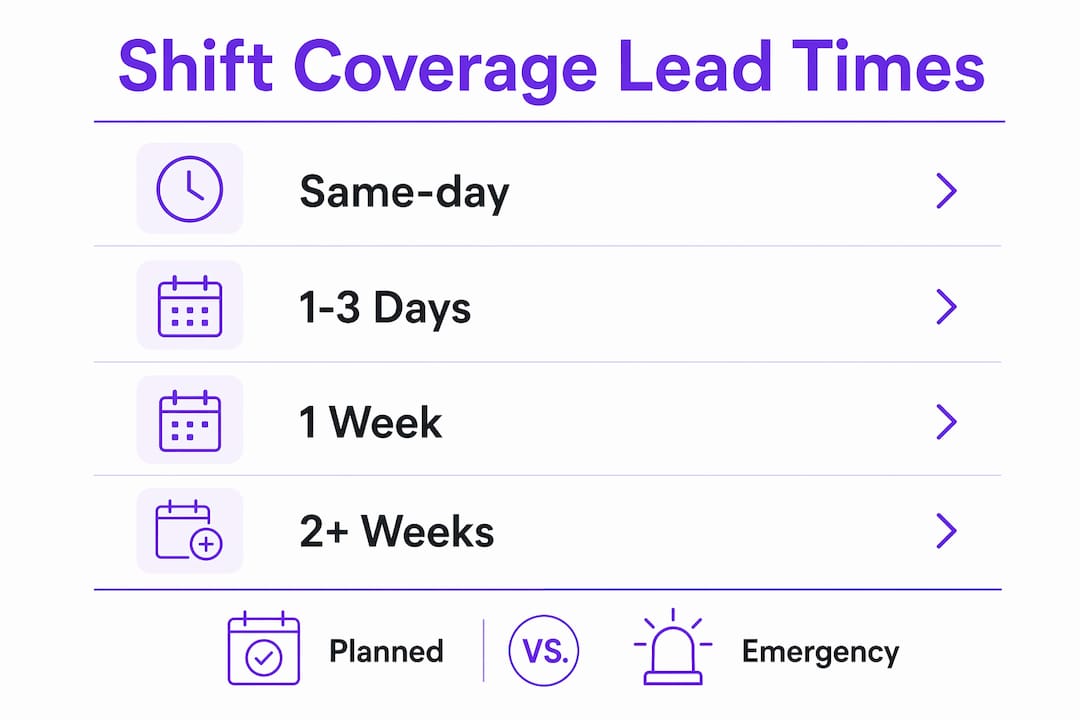
- Confirm lead time: same-day bookings are possible with the right agency, but 24–48 hours is more reliable for planned coverage.
Table of Contents
- What does WorkSafeBC actually require for first aid attendant coverage?
- When do you actually need temporary shift coverage?
- What are your options, and why is a First Aid Temp Agency usually best?
- How do you book a temporary first aid attendant step by step?
- How do you plan for continuous coverage and unplanned absences?
- What affects the price, and what contract terms should you request?
- What documents do you need before the first shift?
- What does coverage look like in practice? Four quick scenarios
- Key takeaways
- The mistake most BC employers make with shift coverage
- Fairsafe: certified first aid temps across BC, ready when you need them
- Useful sources for BC employers
What does WorkSafeBC actually require for first aid attendant coverage?
BC's OHS Regulation, Section 3.16 requires every employer to provide the equipment, supplies, facilities, attendants, and services set out in Schedule 3-A. The minimum level is determined by three variables: worker count per shift, hazard rating (low, moderate, or high), and workplace class (1 through 4). A small low-hazard site with 2–9 workers may only need a personal first aid kit, while a high-hazard construction site with 50–99 workers requires an Advanced First Aid attendant, emergency transportation, and more.
Beyond equipment, the regulation sets clear expectations for attendant conduct and employer obligations:
- Availability: Attendants must be ready to respond within 3–5 minutes of being called, including during breaks.
- Authority: The attendant has full authority over treatment decisions; employers and supervisors must defer to that judgement during an injury event.
- Written assessment: Section 3.16 of the OHS Regulation requires a written first aid assessment covering worker numbers, hazards, likely injuries, barriers to first aid, and transport plans. Review it at least every 12 months or after any significant change.
- Posting: Written first aid procedures must be posted conspicuously throughout the workplace, including the location of first aid, how to call for it, transport routes, and the attendant's authority.
- Substitutes: Employers must have procedures for planned absences and substitutes for unplanned ones.
Pro Tip: Use the WorkSafeBC first aid assessment worksheet before booking a temp attendant. It walks you through worker count, hazard rating, and workplace class so you can confirm the correct OFA level before you call an agency.
When do you actually need temporary shift coverage?
Recognising the trigger early saves you from a compliance gap. The most common situations fall into three categories.

Planned shortfalls are the easiest to manage: vacation, training days, parental leave, or a single-shift hire for a one-day event. Multi-day construction projects with rotating crews also fall here. Book your first aid temp as soon as the schedule is confirmed.
Unplanned absences are where employers get caught. WorkSafeBC expects a substitute to be in place by the halfway point of the shift if the original attendant cannot continue. That is a tight window, and it is why having an agency on speed dial matters. For small events and single-shift sites, even a brief gap in coverage can create liability.
Special circumstances require a higher standard:
- Remote or less-accessible worksites where emergency vehicles may not reach the scene within 10 minutes.
- High-hazard tasks such as confined space entry, work at heights, or demolition.
- Large public events where crowd size pushes the worker-count calculation into Advanced or EMR territory.
When in doubt, book a higher OFA level. A dedicated attendant who cannot be pulled away for other tasks is always the safer choice on a high-hazard site.
What are your options, and why is a First Aid Temp Agency usually best?
There are four practical routes to securing coverage:
- Internal staff with OFA certificates: Works for low-hazard, small-headcount workplaces where the certified employee's regular duties can be instantly abandoned. Breaks down quickly on busy sites.
- Hiring a temporary individual: Faster than recruiting a permanent employee, but you carry the burden of verifying credentials, insurance, and WorkSafeBC standing yourself.
- Contracting a First Aid Temp Agency: The agency verifies certifications, carries its own insurance, provides a WorkSafeBC clearance letter, and manages replacement if the attendant cannot complete the shift.
- Event medics or EMRs: Appropriate for large public events or high-acuity scenarios where Advanced First Aid or Emergency Medical Responder certification is required.
A First Aid Temp Agency removes the administrative risk. Agencies maintain an on-call pool, manage scheduling, and can dispatch a replacement without you having to source one under pressure. For construction sites and industrial projects across Metro Vancouver, Surrey, Burnaby, Langley, and the Fraser Valley, that buffer is the difference between a compliant shift and a WorkSafeBC order.
Pro Tip: On high-hazard sites, insist on a dedicated, non-tasked attendant. Assigning other duties to an attendant is one of the most common compliance breaches in BC. If those duties cannot be instantly abandoned, the arrangement violates OHS Regulation Section 3.18.
How do you book a temporary first aid attendant step by step?
Booking checklist
- Site address, including access instructions and parking.
- Shift start and end times, plus any overtime possibility.
- Maximum number of workers on shift.
- Workplace class and hazard rating (use the WorkSafeBC assessment worksheet if unsure).
- Required OFA level (OFA Level 1, OFA Level 3, Advanced, or EMR).
- Equipment expected on site: AED, oxygen, spinal kit, emergency transport vehicle.
- PPE requirements and site orientation details.
- Contact name and number for the site supervisor.
Sample booking email
Subject: First Aid Temp Request — [Site Name], [Date]
Hi,
We need a certified first aid attendant for the following shift:
- Site: [Address, City]
- Date/Time: [Start] to [End]
- Workers on shift: [Number]
- OFA level required: [OFA Level 1 / OFA Level 3 / Advanced / EMR]
- Equipment needed: [AED / oxygen / spinal kit / other]
- Hazard rating: [Low / Moderate / High]
Please confirm attendant name, certification copy, WorkSafeBC clearance letter, and insurance certificates prior to the shift.
Thank you.
Lead-time guidance
| Booking type | Realistic lead time | Notes |
|---|---|---|
| Same-day emergency | 2–4 hours | Subject to availability; confirm by phone |
| Standard single shift | 24–48 hours | Allows credential verification and orientation |
| Multi-day project | 3–5 business days | Allows rotation planning and equipment confirmation |
| Large event or remote site | 1–2 weeks | Transport plans, extra equipment, and backup attendants needed |
How do you plan for continuous coverage and unplanned absences?
A contingency plan is not optional. WorkSafeBC expects a substitute to be in place by the halfway point of any shift where the original attendant becomes unavailable. Build that expectation into your contract with the agency before the first shift starts.
- Define the replacement window in writing: specify the maximum time from notification to a qualified substitute being on site.
- Maintain an escalation contact list: agency dispatch number, site supervisor, and a secondary agency contact if the primary cannot respond.
- For multi-attendant sites: document which attendant is lead for serious incidents and confirm that lower-certified attendants consult higher-certified ones before any discharge decision.
- Temporary site reduction: if a replacement cannot arrive within the required window, consider reducing the number of workers on site until coverage is restored.
For on-call and industrial shift models, agencies that maintain a standing on-call pool are significantly more reliable than those that source attendants ad hoc.
Pro Tip: Require the agency to provide backup coverage for the full original shift duration, not just the remaining hours. Partial coverage creates a documentation gap that can complicate a WorkSafeBC audit.
What affects the price, and what contract terms should you request?
Cost drivers for temporary first aid staffing in BC:
- OFA level: OFA Level 3 and Advanced attendants command higher rates than OFA Level 1.
- Remote travel: Sites in less-accessible areas of BC incur travel time and mileage costs.
- Equipment included: AED units, oxygen equipment, and spinal kits add to the daily rate.
- Shift length and minimum hours: Most agencies set a minimum booking (commonly 4–8 hours).
- Short-notice and weekend premiums: Same-day and weekend bookings typically carry a surcharge.
For budgeting guidance and low-cost options, plan for a premium on short notice and remote sites. Request transparent line items for equipment and travel rather than a bundled day rate.
Contract terms to request in writing:
- Replacement SLA with a defined response window.
- Cancellation fee structure and minimum notice period.
- Minimum hours per booking.
- Invoicing terms and payment schedule.
- Proof of insurance and WorkSafeBC clearance letter at booking.
What documents do you need before the first shift?
Collect and retain these before the attendant steps on site:
- Attendant certification (OFA Level 1, OFA Level 3, Advanced First Aid, or EMR), verified on arrival per OHS Regulation Section 33.27.
- Photo ID.
- WorkSafeBC clearance letter for the agency.
- Commercial general liability and professional liability insurance certificates.
- Agency contract or statement of services.
On-site paperwork that must be in place before work begins:
- Written first aid procedures posted conspicuously.
- Emergency transport plan with routes in and out of the workplace.
- Location of first aid supplies and facility clearly marked.
- Contact methods for calling the attendant.
Keep digital copies in the site health and safety file. A detailed event documentation checklist covers the posting and records requirements for event-specific sites.
What does coverage look like in practice? Four quick scenarios
Single-shift maintenance or small event (under 20 workers, low-to-moderate hazard): Minimum OFA Level 1 attendant with a basic first aid kit and AED. Book 24–48 hours in advance. Confirm minimum hours and cancellation terms.
Multi-day construction project (20–99 workers, high hazard): A dedicated OFA Level 3 or Advanced First Aid attendant for each shift, with a documented rotation plan and a replacement SLA. Equipment should include oxygen, spinal kit, and emergency transport. Book 3–5 business days ahead and confirm the agency's on-call backup.
Remote or less-accessible worksite: Supplies, equipment, and facilities must be suitable for the site. Include a pre-arranged surface or air transport agreement in the written procedures, with radio frequencies or GPS coordinates so the attendant can act without delay. Higher equipment standards and overnight care provisions may apply.
Large public event (100+ attendees, crowd-based hazard): Event medics or EMRs with a documented lead-attendant structure. Multiple attendants with clear handoff procedures and a written first aid plan that addresses crowd barriers and transport routes. Consider emergency equipment considerations for high-risk outdoor or remote event environments.
Key takeaways
Hiring a certified attendant through a First Aid Temp Agency is the fastest, most reliable way to maintain WorkSafeBC-compliant coverage across planned and unplanned absences in British Columbia.
| Point | Details |
|---|---|
| Confirm OFA level before booking | Use the WorkSafeBC Schedule 3-A table to determine the minimum first aid level based on worker count, hazard rating, and workplace class. |
| Require documents at booking | Collect the attendant's certification, WorkSafeBC clearance letter, and insurance certificates before the shift starts. |
| Build in a replacement SLA | WorkSafeBC expects a substitute by the halfway point of a shift; get that window defined in writing with your agency. |
| Plan for unplanned absences | Maintain an escalation contact list and confirm the agency holds an on-call pool, not just ad hoc sourcing. |
| Fairsafe covers BC same-day | Fairsafe provides OFA Level 1 through Advanced and EMR temps across Metro Vancouver, the Lower Mainland, and the Fraser Valley. |
The mistake most BC employers make with shift coverage
Most compliance problems with first aid attendant shift coverage are not about the wrong OFA level. They are about the wrong setup. An employer books a qualified attendant, then assigns them to operate equipment, supervise a crew, or handle logistics. The moment those duties cannot be instantly abandoned, the arrangement is non-compliant under Section 3.18 of the OHS Regulation, regardless of the attendant's certification level.
The second most common error is treating the replacement SLA as a handshake agreement. When an attendant calls in sick at 6 AM, a vague "we'll try our best" from an agency is not a plan. A written replacement window, an escalation contact, and a confirmed on-call pool are the only arrangements that hold up under a WorkSafeBC inspection.
Record-keeping is the third gap. Certificates expire. Clearance letters lapse. A site that cannot produce current documentation during an audit faces the same consequences as a site with no attendant at all. Keep digital copies, set calendar reminders for recertification dates, and treat the health and safety file as a live document, not an archive.
The practical fix for all three is straightforward: use a First Aid Temp Agency that manages these details as part of its service model, insist on a dedicated non-tasked attendant on higher-hazard sites, and put every SLA in writing before the first shift.
Fairsafe: certified first aid temps across BC, ready when you need them
When a shift needs coverage fast, Fairsafe is a local First Aid Temp Agency built for exactly that situation. Unlike a general staffing agency, Fairsafe specialises in certified first aid and safety temps for construction sites, industrial projects, events, and film productions across Metro Vancouver, the Lower Mainland, Surrey, Burnaby, Richmond, Delta, Langley, Coquitlam, Abbotsford, and the Fraser Valley.
Fairsafe supplies OFA Level 1 and OFA Level 3 attendants, Advanced First Aid attendants, Emergency Medical Responders, and event medics. Every placement comes with a WorkSafeBC clearance letter and insurance certificates on request. Equipment including AED units, oxygen, spinal kits, and emergency transport vehicles can be confirmed before the shift. There are no long-term commitments required: book a single shift, a multi-day project, or ongoing coverage as your schedule demands.
Contact Fairsafe at fairsafe.ca to confirm availability and get a quote for your next shift.
This article is general information for BC employers and does not constitute legal or regulatory advice. Confirm current WorkSafeBC requirements with the official OHS Regulation or a qualified occupational health and safety professional for your specific workplace.
Useful sources for BC employers
These primary sources belong in your site safety file:
- WorkSafeBC OHS Regulation, Part 3: The governing regulation for occupational first aid in BC. Sections 3.15 through 3.21 and Schedule 3-A define minimum attendant levels, employer duties, and attendant responsibilities.
- WorkSafeBC: Know your required first aid supplies and services: The Schedule 3-A tables in plain format. Use this to confirm the correct attendant level for your worker count and hazard rating before booking.
- WorkSafeBC first aid assessment worksheet: A step-by-step worksheet to document your workplace assessment. Complete this before booking a temp attendant and keep it on file for audits.
- WorkSafeBC: Conducting a first aid assessment (2025 campaign): Reiterates the requirement to count the maximum number of workers per shift and document results.
- WorkSafeBC: Supplies, equipment and facilities: Covers emergency transport requirements, first aid room standards, and the 10-minute vehicle response expectation for sites where transport is required.
- On-site first aid in BC: what employers need to know: A practical overview of employer legal duties and BC compliance requirements for first aid attendants.
- CCOHS (Canadian Centre for Occupational Health and Safety): Broader occupational health context and guidance on workplace health and safety programmes across Canada. Consult ccohs.ca for resources that complement WorkSafeBC's BC-specific requirements.