
For most BC employers who need temporary first aid coverage, outsourcing is the right call. Hiring a certified First Aid Temp Agency gives you WorkSafeBC compliance, flexible staffing, and access to qualified OFA and Emergency Medical Responder personnel without the cost of a permanent hire. If you need temp coverage now, contact Fairsafe or use the vetting checklist in Section 5 before you sign any agreement.
Quick stat: Under WorkSafeBC's 2026 guidance, first aid attendants must be available to provide treatment promptly when called, and the central first aid service must be reasonably accessible to all workers. Missing that window is a compliance failure — and a liability.
Table of Contents
- Why outsourcing safety makes business sense for BC employers
- What WorkSafeBC requires and what you cannot delegate to a temp agency
- When does hiring a Safety Temp Agency make the most sense?
- What should you verify before hiring a first aid temp agency?
- How do you integrate temporary safety personnel into your site safely?
- What drives the cost of outsourced first aid coverage?
- Key takeaways
- A note from Fairsafe on what we see in the field
- Fairsafe provides certified temp first aid and safety coverage across BC
- Primary sources and further reading
Why outsourcing safety makes business sense for BC employers
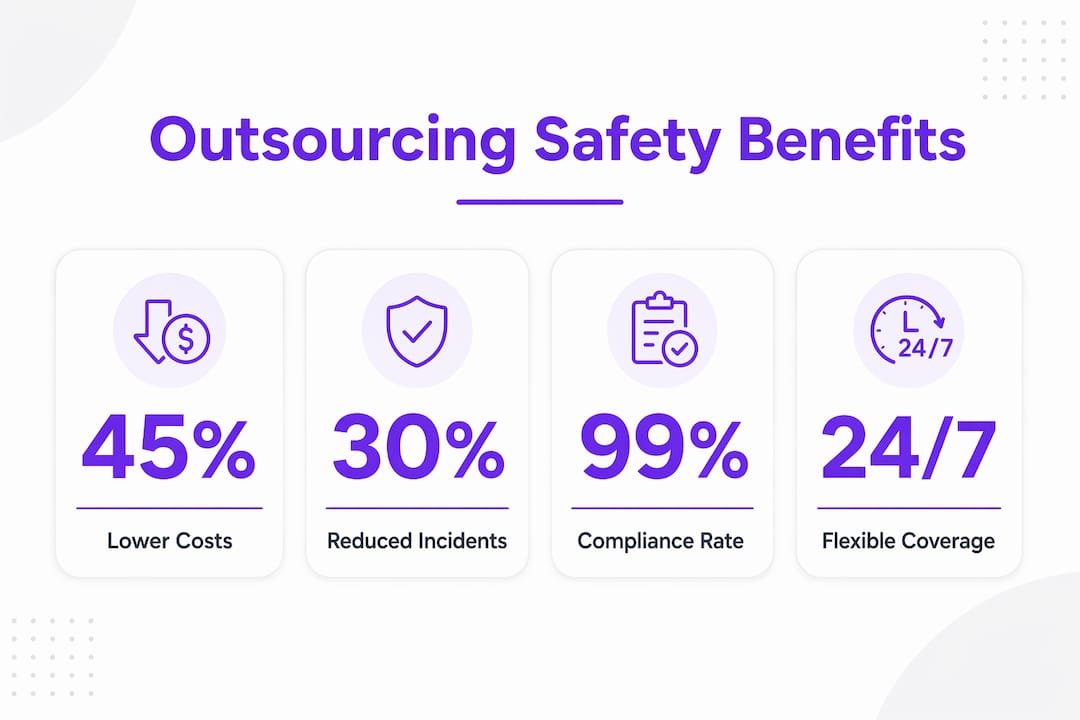
Outsourcing your temporary first aid and safety staffing delivers six concrete advantages that an in-house hire simply cannot match for short-term or variable coverage needs.
- Compliance assurance: Certified OFA attendants arrive with verified credentials aligned to WorkSafeBC's 2025 regulatory amendments, which harmonised BC occupational first aid with CSA standards.
- Flexible staffing: Scale up for a shutdown, a multi-trade construction pour, or a Surrey festival — then scale back down. No severance, no bench time.
- Access to certified personnel: OFA Level 1, 2, and 3 attendants, Advanced First Aid attendants, and Emergency Medical Responders are available on demand.
- Reduced fixed HR costs: Third-party safety personnel reduce the need for full-time safety staff when demand is intermittent, converting a fixed salary into a variable project cost.
- Improved audit readiness: External specialists who rotate across multiple sites identify patterns and uncommon hazards that internal staff may overlook — a direct advantage for COR preparation.
- Faster incident response: A dedicated temp attendant has one job on site. Response times stay within the three-to-five-minute window WorkSafeBC requires.
Consider a general contractor running a multi-trade concrete pour in Burnaby with 60 workers on site. Sourcing a qualified OFA Level 3 temp for a two-day window costs a fraction of a full-time hire and keeps the project on schedule. Or picture an event organiser in Abbotsford who discovers the day before a public gathering that their in-house first aider called in sick. A First Aid Temp Agency fills that gap in hours, not weeks.
The cost of non-compliance — fines, stop-work orders, and reputational damage — consistently exceeds the cost of proper temp coverage.
What WorkSafeBC requires and what you cannot delegate to a temp agency
You can outsource the function. You cannot outsource the liability. Employers remain legally responsible for ensuring first aid compliance even when a temp agency supplies the attendant.

The BC OHS Regulation Part 3 sets out the employer's two-part duty: determine minimum first aid levels based on hazard rating, location, and worker count, then evaluate site-specific circumstances for any additional requirements. That assessment is yours to conduct and document — it cannot be handed off.
| Requirement | Standard | Responsible party |
|---|---|---|
| Attendant response time | Within 3–5 minutes of being called | Employer |
| Central first aid service | — | Employer |
| Substitute for planned absence | In place before the absence begins | Employer / Temp agency by agreement |
| Substitute for unplanned absence | In place by the halfway point of the shift | Employer / Temp agency by agreement |
| Attendant availability during breaks | Attendant must remain in their assigned area | Employer |
WorkSafeBC also requires that attendants are kept free from tasks that interfere with their ability to respond. Assigning a temp attendant to general labour duties is a violation, regardless of who employs them.
Before signing a temp agreement, verify these timing obligations in writing:
- Who provides substitute attendants for planned absences, and how far in advance?
- What is the agency's escalation process for unplanned absences mid-shift?
- How are coverage gaps reported to the employer in real time?
For a deeper look at safety personnel compliance obligations under BC law, the Fairsafe blog covers the 2026 regulatory landscape in detail.
When does hiring a Safety Temp Agency make the most sense?
Outsourcing temporary safety personnel is the right decision in most situations where coverage is variable, short-term, or site-specific. The highest-value scenarios include:
- Last-minute sick calls and unplanned gaps: A temp agency can place a certified attendant within hours, keeping you compliant without scrambling internally.
- Multi-trade construction sites in Metro Vancouver, Langley, or Delta where attendant level requirements shift as the project progresses.
- Remote or less-accessible worksites: A first aid plan for remote construction sites must account for transport barriers — a temp with the right certification and equipment is often the only compliant solution.
- Events and public gatherings: From film productions in Richmond to outdoor festivals in Coquitlam, event safety officers have distinct responsibilities that require specific credentials.
- Shutdowns and maintenance windows: Hazard profiles change during shutdowns; a higher-level attendant may be required for a defined period.
- COR audit support: Third-party safety personnel provide the unbiased operational perspective that COR certification auditors look for.
- Surge staffing during training cycles: When internal attendants are off-site for recertification, a temp fills the gap without a compliance lapse.
An in-house hire still makes sense when your operation runs continuous, high-hazard shifts year-round and the attendant role is genuinely full-time. For everyone else, a Safety Temp Agency is the more practical and cost-effective route.
What should you verify before hiring a first aid temp agency?
Start with the single most important check: the agency must be registered with WorkSafeBC and must provide a current clearance letter on request. No clearance letter means no contract.
- WorkSafeBC registration and clearance letter — request it before any agreement is signed.
- Accepted first aid certificates — confirm OFA Level 1, 2, and 3, Advanced First Aid, and Emergency Medical Responder credentials as applicable to your site.
- Up-to-date training records — ask for documented proof of each attendant's certification expiry date.
- Insurance — commercial general liability and professional liability coverage are both required.
- Background checks — confirm the agency conducts vetting on all placed personnel.
- Equipment provision — clarify whether AED units, oxygen equipment, spinal kits, and first aid supplies are included or billed separately.
- Substitution policy and SLA — get the agency's written commitment on response time for unplanned absences, including the halfway-point rule.
- Incident reporting and recordkeeping — confirm the agency provides documented reports for every incident and near-miss.
- References and COR/audit experience — ask for client references from construction or industrial projects similar to yours.
Common red flags when outsourcing safety include: no clearance letter, vague substitution language, limited or unverifiable insurance, and an inability to provide training records on short notice.
For the contract itself, request these clauses specifically:
- Service levels for response time and substitution timing
- Indemnity language that aligns with your employer responsibilities under the BC OHS Regulation
- A requirement for the agency to provide a WorkSafeBC clearance letter on each assignment
- A confidentiality clause covering incident records and worker health information
BC worksites with higher hazard ratings should also review the OFA3 temp agency requirements before finalising any agreement.
How do you integrate temporary safety personnel into your site safely?
Integration is not optional. A temp attendant who arrives on site without a proper briefing is a compliance risk, regardless of their credentials.
- Pre-shift coordination: Confirm the attendant's certification level and request the WorkSafeBC clearance letter before the shift begins.
- Site orientation and hazard briefing: Walk the attendant through site-specific hazards, emergency exits, muster points, and the first aid station location.
- Communication lines: Assign a radio channel or direct phone contact so the attendant can be reached and can call for support instantly.
- Duty assignment: Confirm the attendant's role in writing. WorkSafeBC requires attendants to be free from tasks that interfere with response availability.
- Recordkeeping and reporting: Establish who receives incident reports and how quickly — before the shift starts, not after an incident occurs.
- Shift handover: Brief the incoming attendant on any incidents, near-misses, or site changes from the previous shift.
- Post-shift debrief: A five-minute debrief catches issues before they become patterns.
Schedule random competency checks and include the temp agency in incident investigations and near-miss reviews. Consistent documentation supports your COR audit trail and demonstrates due diligence to WorkSafeBC inspectors.
Pro Tip: Build a one-page site orientation checklist specifically for temp attendants. Keep it at the site office and have every incoming temp sign it. That single document can demonstrate employer due diligence in a WorkSafeBC inspection or COR audit.
Good operational reporting practices — consistent, timestamped, and filed centrally — apply across industries wherever third-party personnel are integrated into daily operations.
What drives the cost of outsourced first aid coverage?
Price varies based on several factors, and understanding them helps you budget accurately and compare quotes fairly.
- OFA level required: An OFA Level 3 or Emergency Medical Responder commands a higher rate than an OFA Level 1. Your site's hazard rating and worker count determine the minimum level.
- Shift length and timing: Overnight, weekend, and statutory holiday shifts typically carry a premium.
- Remote travel and site access: Sites in less-accessible areas of BC require travel time, accommodation, and sometimes specialised transport, all of which affect cost.
- Equipment provision: AED units, oxygen equipment, and spinal kits may be included or itemised separately. Clarify this before comparing quotes.
- Last-minute or short-notice requests: Agencies that can place a certified attendant within hours charge accordingly. Budget a premium for emergency coverage.
- Number of attendants: Larger or higher-hazard sites may require multiple attendants per shift under WorkSafeBC's 2025 amendments.
Request itemised quotes that separate the attendant rate, travel and standby fees, equipment, and substitution SLA fees. That structure lets you compare agencies on equal terms rather than on headline price alone.
The ROI case is straightforward: fewer incidents, reduced downtime, and lower insurance exposure offset staffing cost over time. Firms that engage external safety specialists report longer lost-time-injury-free runs and improved operational continuity. For employers pursuing COR, the audit-readiness value adds another layer of return.
Key takeaways
Outsourcing certified first aid and safety temp personnel is the most practical, compliant, and cost-effective choice for BC employers who need flexible temporary coverage under WorkSafeBC's 2026 requirements.
| Point | Details |
|---|---|
| Employer liability stays with you | You can outsource the attendant role, but WorkSafeBC holds the employer responsible for compliance at all times. |
| Response time is non-negotiable | Attendants must be available to provide treatment within three to five minutes of being called, and the central first aid service must be accessible to all workers. |
| Clearance letter is the first check | Never engage a temp agency without a current WorkSafeBC clearance letter and proof of CGL and professional liability insurance. |
| Integration requires a written briefing | Temp attendants must receive a site orientation, hazard briefing, and duty assignment before their first shift begins. |
| Fairsafe covers BC from last-minute to long-term | Fairsafe supplies OFA Level 1–3, Advanced First Aid, EMR, and event medics with equipment across Metro Vancouver, the Fraser Valley, and beyond. |
A note from Fairsafe on what we see in the field
The gap between knowing the rules and actually meeting them on a busy construction morning in Coquitlam or at a public event in Langley is where employers get caught. Certification requirements, substitution timing, and equipment standards have all tightened since WorkSafeBC's 2025 amendments, and the sites that struggle most are the ones trying to manage temporary first aid coverage without a reliable agency relationship in place.
Fairsafe is registered with WorkSafeBC and can provide a clearance letter for every assignment. Our temp attendants carry verified credentials, and we maintain commercial general liability and professional liability insurance.
If your site needs coverage, reach out at fairsafe.ca and ask for an itemised quote and our current clearance letter.
Fairsafe provides certified temp first aid and safety coverage across BC
Fairsafe is the direct alternative to scrambling for last-minute first aid coverage or carrying a full-time attendant on payroll for intermittent needs. BC employers get certified temp personnel placed quickly, with transparent rates and no long-term staffing contract required.
Fairsafe supplies OFA Level 1, 2, and 3 attendants, Advanced First Aid attendants, Emergency Medical Responders, event medics, and construction safety personnel throughout Metro Vancouver, the Lower Mainland, the Fraser Valley, and across British Columbia. Equipment, including AED units, oxygen, and spinal kits, is confirmed and arranged before each assignment. Every placement is backed by WorkSafeBC registration, a current clearance letter, and documented training and vetting records.
Whether you need a single attendant for a last-minute shift in Surrey or a full safety team for a multi-week industrial shutdown in the Fraser Valley, Fairsafe is structured to respond. Request your itemised quote and clearance letter at fairsafe.ca.
Primary sources and further reading
Keep printed copies of your WorkSafeBC clearance letters and OFA certificates on file at the worksite. Inspectors can request them at any time.
- Employer responsibilities: First aid — WorkSafeBC
- First aid attendants — WorkSafeBC
- New first aid regulations roll out across BC — WorkSafeBC (2025)
- OHS Guidelines for Part 3: Occupational First Aid — WorkSafeBC
- First aid regulation FAQ — WorkSafeBC
- Why safety non-compliance is costly for BC employers — Fairsafe blog
- Role of safety personnel in compliance: a 2026 BC guide — Fairsafe blog
- On-site first aid in BC: what employers need to know — Fairsafe blog